
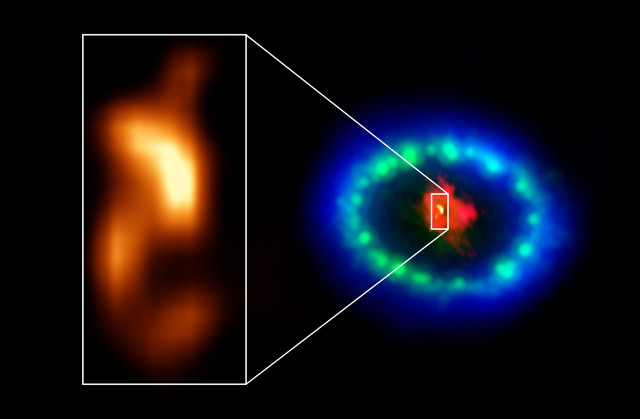
Two articles – available here and here – published in “The Astrophysical Journal” reports two studies on the supernova SN 1987A remnants. Two teams of researchers led by Phil Cigan of the British University of Cardiff and Dany Page of the National Autonomous University of Mexico respectively used observations conducted with the ALMA radio telescope and follow-up theoretical studies to bring evidence that a neutron star formed after the supernova. If these results are confirmed, it would be the youngest known neutron star.
The supernova SN 1987A was spotted in the Large Magellanic Cloud, one of the Milky Way’s dwarf satellite galaxies, on the night of February 23-24, 1987. In recent years, astronomers studied the remnants using the ALMA (Atacama Large Millimeter/submillimeter Array) radio telescope, inaugurated in March 2013, to exploit its power and sensitivity. Interesting results were published in July 2017, and studies continued by various teams, also thanks to new observations with ALMA that benefited from the improvements to the radio telescope and the processing of the data collected.
The explosion of the star that was classified as Sanduleak -69° 202a, or simply Sk-69 202, the blue supergiant progenitor of the supernova SN 1987A, left a compact core that could have become a neutron star or a black hole, depending on its mass. On the same day that SN 1987A was detected, from the same direction, neutrinos were also detected, an event that scientists interpreted as a clue that it was a neutron star. However, for over thirty years no one could find evidence of its nature, at least so far.
The team led by Phil Cigan obtained very high-resolution images of the supernova SN 1987A remnants that revealed a blog of gas and dust at very high temperatures inside those remnants. Mikako Matsuura, another researcher from the University of Cardiff who is part of the team that conducted the observations, explained that there must be something in the cloud that heats gas and dust by making them shine, which is why the team suggested that there’s a neutron star in that cloud of dust.
The top image (ALMA (ESO/NAOJ/NRAO), P. Cigan and R. Indebetouw; NRAO/AUI/NSF, B. Saxton; NASA/ESA) shows the very hot blog of gas seen by the ALMA radio telescope at the center of the remains of the supernova SN 1987A in the insert.
One doubt for Phil Cigan’s team was that the object was far too bright for a neutron star, but the other study, conducted by Dany Page’s team, confirms that interpretation with theoretical work indicating that a very young neutron star can have those characteristics. When the supernova SN 1987A was discovered, Dany Page was working on his doctorate and changed the course of his career, leading him to work on it to discover its secrets.
The models used by Dany Page’s team precisely predict that a neutron star would be where the incandescent cloud detected by ALMA was observed, where it was propelled by the supernova. It would have an estimated temperature of 5 million degrees Celsius, enough to provide an amount of energy that explains the observed blob’s brightness.
The neutron star is not of the pulsar type, whose energy depends on its rotation speed and the power of its magnetic field. Dany Page explained that these parameters should have very precise values to match the observations while the thermal energy emitted by the young neutron star’s hot surface naturally adapts to the data.
James Lattimer of Stony Brook University in New York, part of Dany Page’s team, is another veteran of the supernova SN 1987A studies since in 1989 he was among the authors of an article describing the results of the analysis of the neutrino signal coming from it. He explained that neutrinos suggested that a black hole never formed and it would be difficult to explain the brightness observed in the blob with the presence of a black hole. The team compared all the possibilities and concluded that a hot neutron star is the most likely explanation.
The cloud of gas and dust continues to expand and is consequently thinning out. It is a very slow process, so it may take decades before it’s possible to see directly if there really is a neutron star at its center. It’s a study of the supernova SN 1987A remnants very interesting for astronomers, who will continue to collect data on their evolution.

Permalink