
An article published in the journal “Nature Communications” reports the discovery of 15 stars that contain an unusual amount of phosphorus but also of other elements such as magnesium, silicon, oxygen, aluminum, and cerium, an anomaly that suggests a new type of object. A team of researchers led by Thomas Masseron of the Instituto de Astrofísica de Canarias (IAC) examined a large number of infrared spectra obtained during the Sloan Digital Sky Survey together with the optical spectrum of the brightest of the phosphorus stars obtained using the Echelle spectrograph installed at the Nordic Optical Telescope. The possible explanations will have to be tested, but this discovery explains the abundance in the Milky Way of phosphorus, an indispensable element for Earth’s life forms.
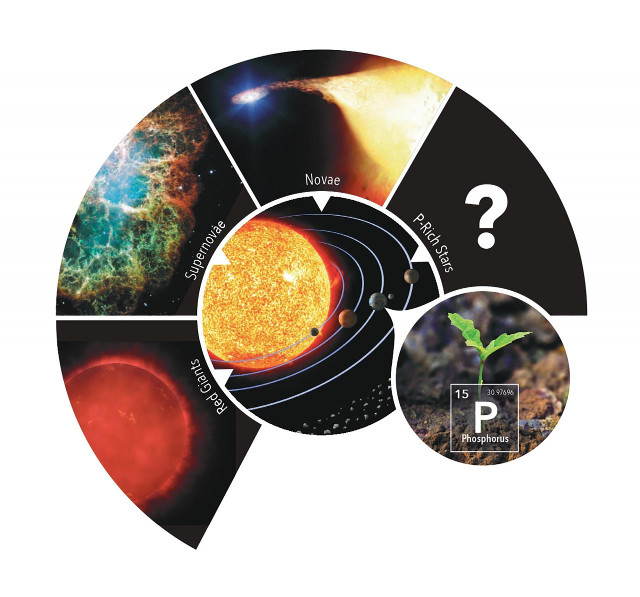
Phosphorus is one of the elements that are created by nuclear fusion processes inside stars, but its abundance in the Milky Way and therefore in the solar system is a source of perplexity because the theoretical models of chemical evolution in the galaxy can’t explain it. The mystery is interesting also because phosphorus is one of the elements that form DNA and RNA and is crucial in energy exchanges within living organism cells. The image (Courtesy Gabriel Pérez Díaz, SMM (IAC). All rights reserved) shows a diagram with the possible sources of phosphorus in the solar system.
The detection of phosphorus in stellar spectra is very difficult because it has a very weak identifying line, which is a sort of chemical fingerprint. The APOGEE (Apache Point Observatory Galactic Evolution Experiment) spectrographs used for the various runs of the Sloan Digital Sky Survey operate in the near-infrared, in what is technically called the H band, in which the phosphorus line is present. Consequently, Thomas Masseron’s team could use the database obtained to search for the objects in which there was a clear presence of phosphorus among hundreds of thousands of stars in the Milky Way, especially red giants.
The 15 objects found were examined for the abundance of other chemical elements using as control sample another group of very similar stars with a very low presence of phosphorus. The result is that the 15 objects show an abnormal abundance of other elements such as magnesium, silicon, oxygen, aluminum, and cerium. These are stars at an advanced stage of their life so the researchers also tried to understand what kind of progenitors they may have had.
Phosphorus is produced by stars of the asymptotic giant branch with a mass between one and three times the Sun’s and by massive stars with a mass between ten and three hundred times the Sun’s, which end their life in a supernova. An analysis of the characteristics and evolution of these objects led the researchers to conclude that massive stars are the prime candidates for substantial phosphorus production. It could occur under certain conditions, but the existing models can’t reproduce the abundance of the various elements in these stars.
In the end, the researchers found sources of phosphorus that may explain the abundance of this element in the solar system, but this answer led to new questions. New studies are needed to understand if it’s a new class of objects, stars in which particular nuclear fusion processes occur that determine the abundance of certain elements. It’s another subject of research for astrophysicists that is not only theoretical since the results of these processes favor the birth and sustenance of life forms such as the Earth’s.
