
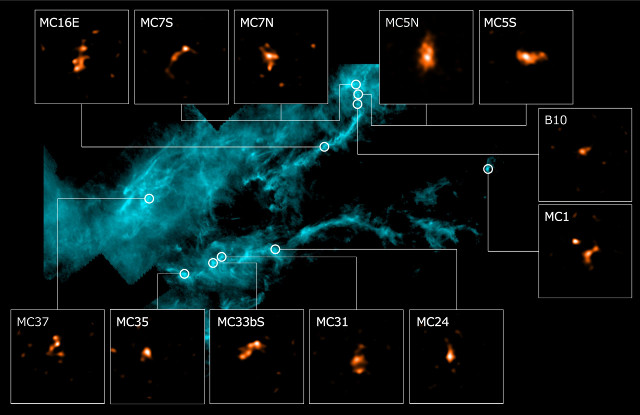
Two articles, one published in “The Astrophysical Journal” and one in “The Astrophysical Journal Letters”, report a census of what were called stellar embryos in the Taurus Molecular Cloud. A team of researchers used the ALMA radio telescope to observe 32 prestellar objects and 7 protostars that offer new insights into the processes leading to the birth of stars. One of the articles focuses on the discovery of a bipolar outflow formed by a pair of gas streams that could be clues to the birth of a star.
The Taurus Molecular Cloud is a region where star formation processes are underway, and for this reason, it was already the target of many observations. The concentrations of gas and dust that coalesce to form new stars pose a problem for these studies because they filter out many electromagnetic wavelengths. The ALMA (Atacama Large Millimeter/submillimeter Array) radio telescope, inaugurated in March 2013, is very useful because it can detect some of the wavelengths that pass through those materials.
For this study, the researchers only used ALMA’s 12 7-meter antennas, which is called the ALMA-ACA (Atacama Compact Array) or Morita array, not the entire array which also includes 54 12-meter antennas. That’s because the complete radio telescope has problems observing featureless objects such as those that were defined “stellar eggs” while the Morita array allows to see objects with a smooth structure. Thanks to this choice, the team led by astronomer Kazuki Tokuda of Osaka Prefecture University and the National Astronomical Observatory of Japan (NAOJ) was able to obtain information on those eggs’ internal structure.
The image (ALMA (ESO/NAOJ/NRAO), Tokuda et al., ESA/Herschel) shows an infrared image of the Taurus Molecular Cloud as seen by the Herschel space observatory. The circles indicate the stellar eggs, magnified in the inset showing the ALMA radio telescope’s observations.
The observations showed a difference between two different groups of objects given by the density of the gas inside their cores. When the density inside a core exceeds the threshold of about one million hydrogen molecules per cubic centimeter, the gravity force causes an egg to turn into a star. In the case of one of the objects studied, the researchers noticed a faint but clear gas stream from the poles. This matches the process expected just before a star’s birth. It’s the first object at that formation stage discovered in the Taurus Molecular Cloud while other candidates have been found in other star-forming regions.
The different characteristics of the various objects, which led to the division of the cores surveyed into 32 prestellar objects and 7 protostars, show some of the very early stages of star formation. For this reason, the researchers believe this census offers motives for a number of follow-up studies. In some cases, such as some possible objects very close to the moment of a star’s birth, the use of the ALMA radio telescope’s entire array could be useful. In other cases, other instruments could collect emissions at other wavelengths.
