
The Nature group has dedicated a special issue to the dwarf planet Ceres with a series of articles published in its journals. Various teams of researchers studied different aspects of the geology of Ceres with particular attention to the presence of water and hydrated sodium chloride, in very simple words table salt mixed with water. There are confirmations of the presence in the past of an underground ocean of which a strong presence of salts significantly lowered the freezing point. The salts present in the famous bright spots such as that in Occator Crater are among the remains of that ocean: they’re mainly sodium carbonate and ammonium chloride, but there’s also sodium chloride.
The mission of the Dawn space probe ended in late October 2018 leaving a wealth of data to study. The bright spots were known even before Dawn reached the dwarf planet Ceres, but the observations conducted with telescopes from the Earth and its orbit didn’t enable to understand their composition. Only thanks to the detections conducted using Dawn’s instruments it was possible to understand that those are salts, and research continued to establish their exact composition.
An interesting conclusion is that in the conditions on Ceres the salts dehydrate within a few hundred years, but the findings indicate that they still contain water, so it still flows and rises to the surface in regions such as Occator crater. It’s probably no longer a large ocean, but evidence suggests that there are still areas where very salty water is in a liquid state.
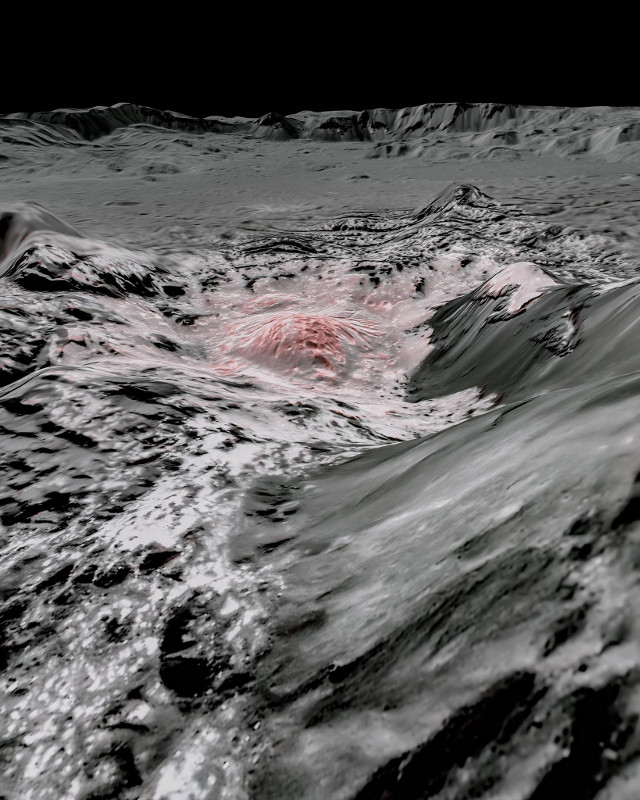
Analyzes of the data about the salts indicate that they’re mainly sodium carbonate and ammonium chloride, but there’s also hydrated sodium chloride, the common table salt bound to water. The mixture of these salts and water was found for example on the top of Cerealia Facula, one of the structures present in Occator Crater. They’re relatively young structures in geological terms as some are estimated to be less than two million years old.
The image (NASA/JPL-Caltech/UCLA/MPS/DLR/IDA) shows a mosaic created using infrared and visible wavelength photos of an Occator Crater area. Cerealia Facula is visible in a reddish color due to the presence of salts.
The geological structures in the areas where there are salt concentrations were formed through long-lasting processes, and these new studies confirm that there might still be some activity. Maria Cristina De Sanctis of the Italian National Institute of Astrophysics in Rome, one of the authors of various studies on Ceres, compared the dwarf planet to Enceladus, the moon of Saturn with an underground ocean, one of the main candidates in the search for extraterrestrial life. That type of moon has the advantage of being constantly heated by their planet’s gravitational tides.
After the end of the Dawn space probe mission, it’s difficult to look for changes that would confirm that Ceres is still active. The discoveries about this dwarf planet are important because they show that there are places in the solar system where various processes can generate complex chemical reactions that include the formation of life’s building blocks.
