
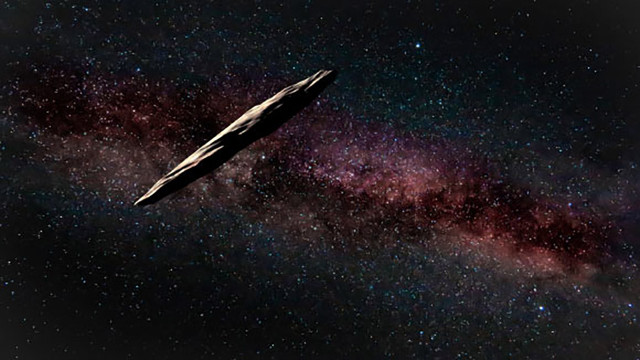
The interstellar asteroid ‘Oumuamua can’t be a hydrogen iceberg
An article published in “The Astrophysical Journal Letters” reports a study on the interstellar asteroid 1I/2017 U1, known as ‘Oumuamua, that offers evidence that it’s not some sort of hydrogen iceberg. Abraham Loeb of the Center for Astrophysics | Harvard & Smithsonian (CfA) and Thiem Hoang of the Korea Astronomy and Space Science Institute (KASI) examined the premise of the study that proposed that possibility, that an object composed mostly of molecular hydrogen could form within a giant molecular cloud and be pushed in interstellar space. The researchers concluded that various processes would cause the sublimation of molecular hydrogen, so an iceberg probably couldn’t be formed or would be destroyed by the stars that formed in the same molecular cloud before it could even end up in interstellar space.
