
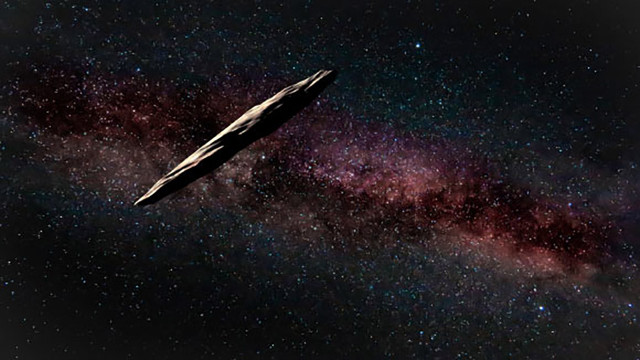
An article published in “The Astrophysical Journal Letters” reports a study on the interstellar asteroid 1I/2017 U1, known as ‘Oumuamua, that offers evidence that it’s not some sort of hydrogen iceberg. Abraham Loeb of the Center for Astrophysics | Harvard & Smithsonian (CfA) and Thiem Hoang of the Korea Astronomy and Space Science Institute (KASI) examined the premise of the study that proposed that possibility, that an object composed mostly of molecular hydrogen could form within a giant molecular cloud and be pushed in interstellar space. The researchers concluded that various processes would cause the sublimation of molecular hydrogen, so an iceberg probably couldn’t be formed or would be destroyed by the stars that formed in the same molecular cloud before it could even end up in interstellar space.
The interstellar asteroid discovered in October 2017 that was eventually formally classified as 1I/2017 U1 and named ‘Oumuamua has been the subject of various studies to try to understand its origin and composition. An article published in “The Astrophysical Journal Letters” in June 2020 offered an explanation for the strange characteristics found concluding that it could be formed mainly of molecular hydrogen and that it could have originated in the heart of a giant molecular cloud.
The hydrogen iceberg theory was interesting also because it suggested that there could be many of them, to the point that some researchers considered molecular hydrogen ice as a candidate to explain the gravitational effects attributed to dark matter. For this reason, Abraham “Avi” Loeb and Thiem Hoang examined it to understand if such an object could form and survive an interstellar journey and the conclusion was negative.
The two researchers looked at various possible problems that could even prevent the formation of a hydrogen iceberg. The various space objects are formed by accretion, with various smaller objects coming together. Even a very low-speed collision of two grains containing frozen hydrogen would generate enough friction to sublimate it, leaving only the other materials. Basically, an asteroid of rock and ice of other materials such as water could form but the presence of hydrogen ice would be minimal if at all.
Even if a hydrogen iceberg could form within a giant molecular cloud, it would have major problems surviving a long journey. In particular, the emissions of the stars that formed in the same molecular cloud would already cause a remarkable sublimation of its hydrogen. Interstellar radiation, including cosmic background radiation, and cosmic rays would also cause a sublimation that would be slow but within millions of years would cause the dispersion of hydrogen ice.
The limited information on the interstellar asteroid ‘Oumuamua makes it difficult to ascertain its composition. However, there’s interest in an object that came from another star system, so studies continue. In science, ruling out a theory is progress too.
