August 2020

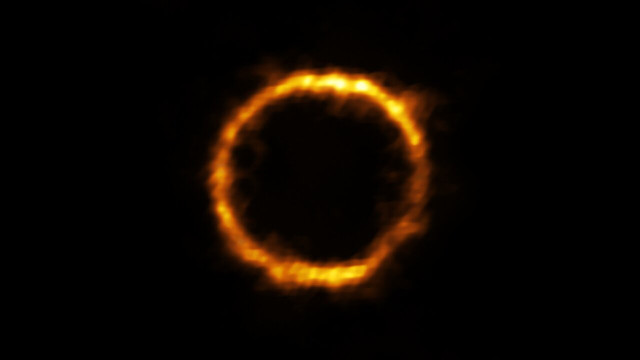
The galaxy SPT0418-47 (Image ALMA (ESO/NAOJ/NRAO), Rizzo et al.)

An article published in the journal “Nature” reports the study of a primordial galaxy we see as it was when the universe was 1.4 billion years old and resembles the Milky Way, a surprise because we see it when it was very young, and according to current theories should be turbulent and unstable. A team of researchers led by Francesca Rizzo, a Ph.D. student at the Max Planck Institute for Astrophysics in Germany, used the ALMA radio telescope to observe this galaxy, cataloged as SPT-S J041839-4751.9, or simply SPT0418-47. Help came from a gravitational lens that magnified the image, allowing to see the similarities with the Milky Way and gather new information on the early stages of galaxy evolution.

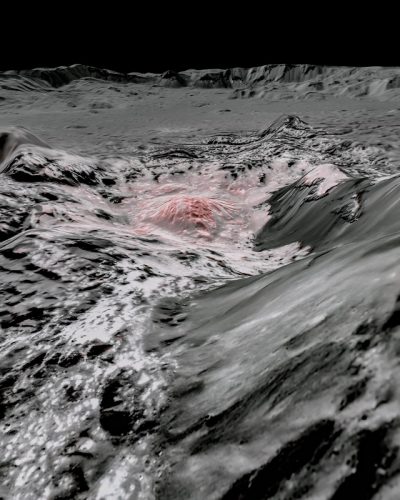
Cerealia Facula in Occator Crater

The Nature group has dedicated a special issue to the dwarf planet Ceres with a series of articles published in its journals. Various teams of researchers studied different aspects of the geology of Ceres with particular attention to the presence of water and hydrated sodium chloride, in very simple words table salt mixed with water. There are confirmations of the presence in the past of an underground ocean of which a strong presence of salts significantly lowered the freezing point. The salts present in the famous bright spots such as that in Occator Crater are among the remains of that ocean: they’re mainly sodium carbonate and ammonium chloride, but there’s also sodium chloride.

The stellar eggs seen by ALMA

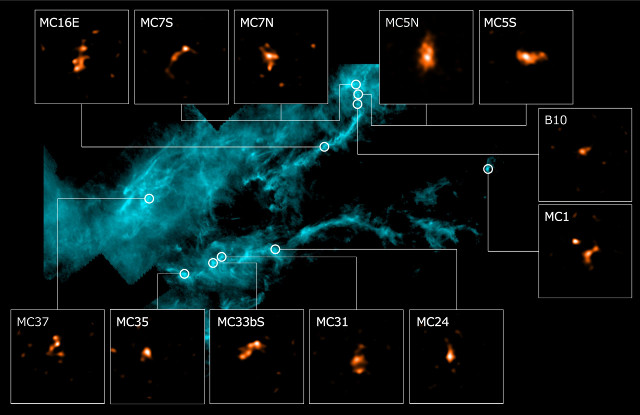
Two articles, one published in “The Astrophysical Journal” and one in “The Astrophysical Journal Letters”, report a census of what were called stellar embryos in the Taurus Molecular Cloud. A team of researchers used the ALMA radio telescope to observe 32 prestellar objects and 7 protostars that offer new insights into the processes leading to the birth of stars. One of the articles focuses on the discovery of a bipolar outflow formed by a pair of gas streams that could be clues to the birth of a star.

The possible origin of phosphorus

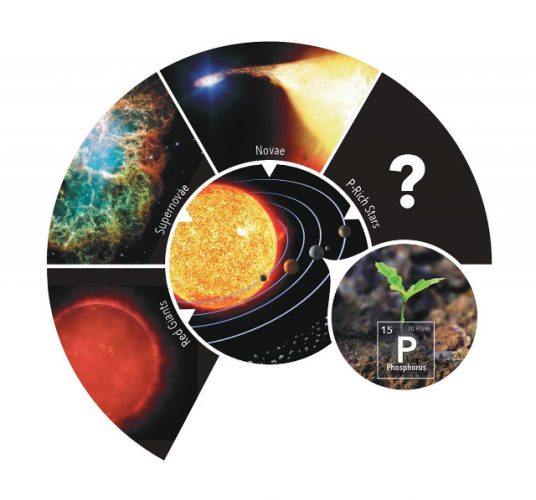
An article published in the journal “Nature Communications” reports the discovery of 15 stars that contain an unusual amount of phosphorus but also of other elements such as magnesium, silicon, oxygen, aluminum, and cerium, an anomaly that suggests a new type of object. A team of researchers led by Thomas Masseron of the Instituto de Astrofísica de Canarias (IAC) examined a large number of infrared spectra obtained during the Sloan Digital Sky Survey together with the optical spectrum of the brightest of the phosphorus stars obtained using the Echelle spectrograph installed at the Nordic Optical Telescope. The possible explanations will have to be tested, but this discovery explains the abundance in the Milky Way of phosphorus, an indispensable element for Earth’s life forms.

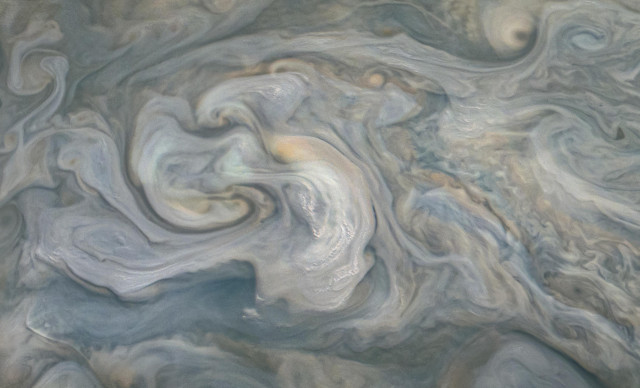
Clouds on Jupiter seen by Juno (Image NASA/JPL-Caltech/SwRI/MSSS/Kevin M. Gill © CC BY)

Three articles, one published in the journal “Nature” and two published in the journal “Geophysical Research: Planets”, report various aspects of research on the clouds of the planet Jupiter. Three teams of researchers with various members in common, coordinated by the French CNRS’s Laboratoire Lagrange and NASA’s JPL, used data collected by the Juno space probe to analyze various aspects of the role of water in the violent storms in the Jovian atmosphere. Lightning strikes originate in a solution of water and ammonia, substances that can form a sort of hailstones, nicknamed mushballs by the researchers, which play a key role in the atmospheric dynamics of this gas planet.