
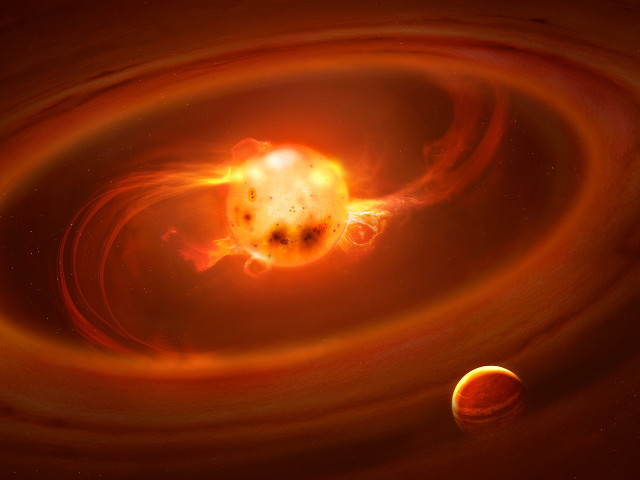
An article published in the journal “Nature” reports the results of observations of the very young TW Hydrae system in which for the first time the columns of materials that contribute to the formation of new stars have been directly observed. A team of researchers part of the GRAVITY collaboration that runs the instrument with that name mounted on ESO’s VLTI in Chile used it to obtain the best details ever studying TW Hydrae. This star has yet to complete its formation, so these observations provide new details on those processes.
About 175 light-years away from Earth, the star TW Hydrae is a little smaller than the Sun and is estimated to be only about 10 million years old. The relatively short distance and very young age make it a very interesting target from a scientific point of view. The protoplanetary disk’s orientation is favorable since it shows its “face” towards the Earth allowing excellent observations. An article published in “Astrophysical Journal Letters” in March 2016 reported the observations of a protoplanet in its formation phase in the TW Hydrae system, now another study focused on the star.
The study of various protostars is helping to reconstruct star formation mechanisms. They include accretion due to the gas that a protostar attracts from the circumstellar disk that surrounds it. Theoretical models describe this accretion with the interactions between protostar and disk, but so far no one could observe it in the known protostars. That was because the level of detail required to observe this interaction was previously impossible and still is with a single telescope. However, ESO’s Very Large Telescope (VLT) in Chile includes four telescopes that can be used independently or as a single instrument with an interferometer which, consequently, is called VLTI.
The GRAVITY instrument used the full power and sensitivity of the VLTI to observe the inner part of the circumstellar disk around TW Hydrae in an unprecedented level of detail. Near-infrared emissions showed gas streams being attracted to the protostar. That’s a process predicted by the models and known as magnetospheric accretion because in addition to the force of gravity there’s the protostar’s magnetic field that drives those materials.
The researchers intend to keep on using the GRAVITY instrument to obtain a more detailed reconstruction of the physical processes taking place near the star TW Hydrae. This will also help to understand the structure of its magnetic field, an important part of understanding the processes that are leading the protostar towards its main sequence, the one in which it will spend its normal life that will last several billion years.
