
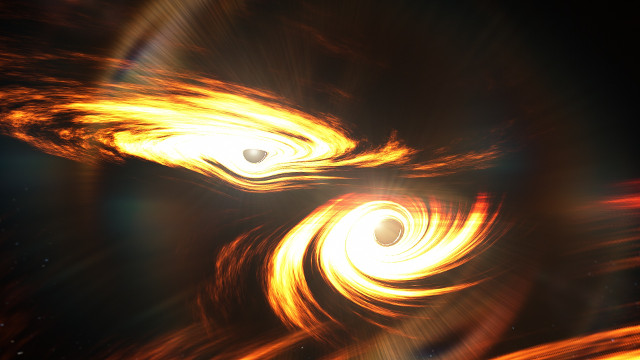
Gravitational waves detected from a merger that generated an intermediate-mass black hole
Two articles, one published in the journal “Physical Review Letters” and one in “The Astrophysical Journal Letters”, report various aspects of an analysis of the data collected by the LIGO and Virgo Collaborations on the merger between two black holes of which the gravitational waves have been detected in the event cataloged as GW190521. The two black holes involved had masses out of the ordinary, estimated at 66 and 85 times the Sun’s, for a total mass of about 150-151 times the Sun’s. The black hole produced has a mass estimated at 142 times the Sun’s, which means that about 9 solar masses were turned into energy during that event to form an intermediate-mass black hole, the first observed at its birth.
