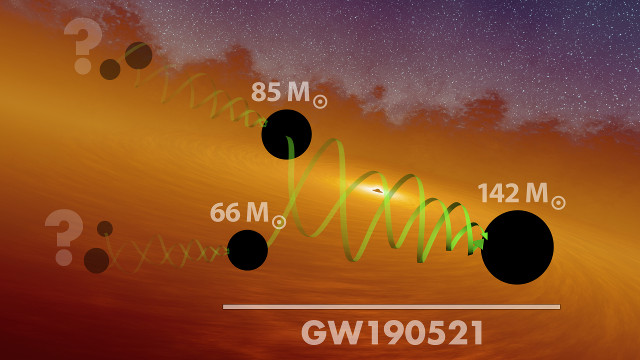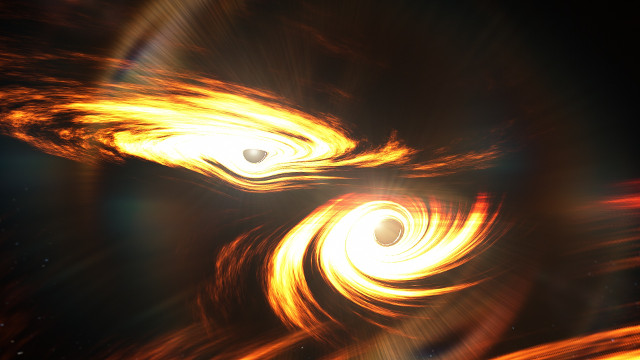
Two articles, one published in the journal “Physical Review Letters” and one in “The Astrophysical Journal Letters”, report various aspects of an analysis of the data collected by the LIGO and Virgo Collaborations on the merger between two black holes of which the gravitational waves have been detected in the event cataloged as GW190521. The two black holes involved had masses out of the ordinary, estimated at 66 and 85 times the Sun’s, for a total mass of about 150-151 times the Sun’s. The black hole produced has a mass estimated at 142 times the Sun’s, which means that about 9 solar masses were turned into energy during that event to form an intermediate-mass black hole, the first observed at its birth.
The third round of observations jointly conducted by the LIGO and Virgo Collaborations using their gravitational wave detectors made it possible to record a significant amount of events. In most cases, these were mergers of two black holes that normally had masses a few times the Sun’s. The event recorded on May 21, 2019, cataloged as GW190521, is truly exceptional because the two black holes have very high masses, difficult to explain as what’s left of as many supernovae.
In the estimates of the two black holes’ masses, the probability peaks are at 66 and 85 solar masses, and this means that the former could be within the possible limits for theoretical models about the formation of a black hole from a star collapse, but the latter is beyond them. This means that at least the 85-solar-mass black hole was likely the result of a previous merger. Actually, the masses of both progenitor black holes in the GW190521 event are close to those of the black holes produced in some other recorded merger events, such as GW170729, which produced a black hole also of about 85 solar masses.
The out-of-normal masses of the black holes involved in the GW190521 event led the researchers to discuss possible alternative explanations such as an amplification of gravitational waves by a gravitational lens. This and other possible exotic events that also include cosmic strings have been considered very unlikely or discarded entirely.
The GW190521 event emitted a short signal, lasting only a tenth of a second, but so intense that it reached Earth about 7 billion years after the merger of the two black holes. The energy of the signal was enough to cover such a large distance also because about 9 solar masses were turned into energy following that merger.
The black hole resulting from the GW190521 event falls within the class of the intermediate-mass black holes, so called because they form a class between stellar-mass black holes and supermassive black holes. In the estimate of its mass, the peak probability is about 142 times the Sun’s mass, marking the first observation of the birth of a black hole of this class. They may be rare, and so far only indirect traces have been found, but at least some of them may be the “seeds” of supermassive black holes. This is another research frontier to which gravitational-wave astronomy could provide considerable help.
The image below (LIGO/Caltech/MIT/R. Hurt (IPAC)) shows an illustration of a possible hierarchy of black holes with successive mergers. The two progenitors of the GW190521 event could be the result of previous mergers that later merged into an intermediate-mass black hole.
The GW190521 event will keep on being studied, and developments in gravitational-wave astronomy offer the hope of detecting more events involving black holes of considerable mass to obtain more information. The LIGO and Virgo detectors could lead to new discoveries about these extreme objects.