
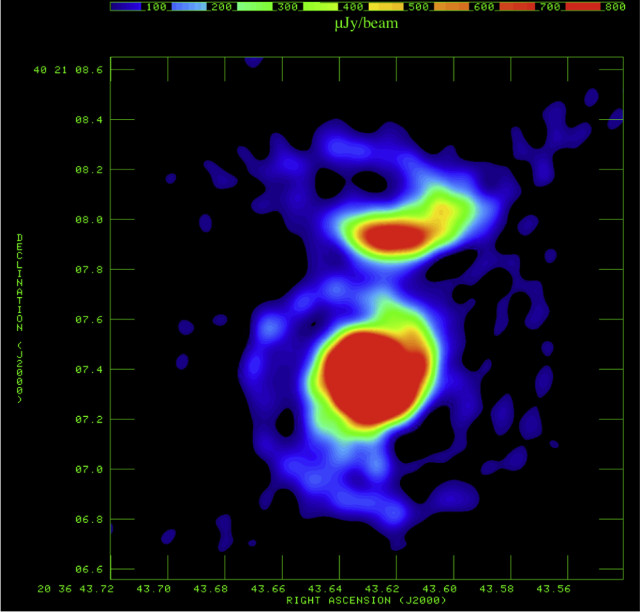
An article published in “The Astrophysical Journal Letters” reports a study of the WR 147 system, and in particular of one of the two stars that form it that is now reaching the end of its life, a massive star that is a very hot giant which belongs to the category of Wolf-Rayet stars. A team of researchers used the VLA radio telescope to study the radio emissions from this star, detecting very strong stellar winds colliding with those of its companion, another giant star but not yet at the end of its life. This phenomenon generates very powerful vortices of materials that look like cosmic pinwheels.
About 2,100 light-years away from Earth, the WR 147 system includes two very massive stars that are as distant as Neptune is from the Sun. It may seem like a considerable distance, but it wasn’t until the 1990s that astronomers were able to establish that they were two stars and not just one. The most massive star, now identified as WR 147S, has a mass estimated to be around 51 times the Sun’s, and now that it’s in the final phase of its life it has a brightness that is two million times the Sun’s. This poses a problem in the sense that its brightness overwhelms its companion’s, now identified as WR 147N, making it difficult to understand the characteristics of what is still another very bright giant star.
The star WR 147S is also interesting for the interaction with its companion. In a binary system, a Wolf-Rayet star that is going through rapid and violent transformations in astronomical terms ejects enormous amounts of materials that form pinwheels by circling the two stars after those materials collide with the companion’s stellar wind. Until now, however, this phenomenon was seen in systems where the Wolf-Rayet star belonged to the subcategory WC, where the main spectral line was that of carbon and helium. Instead, WR 174S has a main nitrogen line, so it belongs to the WN subcategory, the first of its kind to generate those pinwheel vortices.
The image (Courtesy Rodríguez et al. 2020) shows a false-color image of WR 147 obtained with the VLA at 15 GHz showing the two stars of the system with the vortices around them. In the area where the materials ejected from the Wolf-Rayet star collide with its companion’s stellar winds, the particles are accelerated, emitting synchrotron radiation, observed thanks to their radio emissions. On the other hand, no dust plumes are formed in the WR 147 system as in other star systems with WS-class Wolf-Rayet stars.
These observations of the WR 147 system indicate the possibility of examining such systems with radio emission detections to map the pinwheel effect instead of infrared emissions. This will help to understand the chaotic processes taking place in stars at the end of their life that will one day explode into supernovae.
