
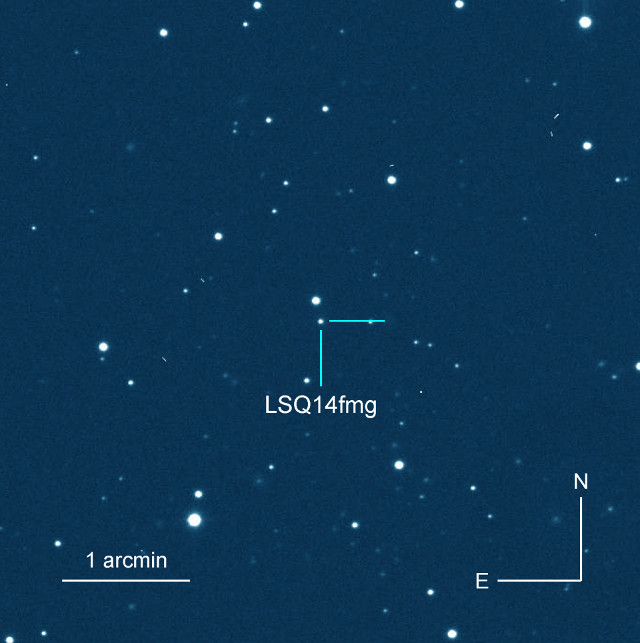
An article published in “The Astrophysical Journal” reports a study on the Type Ia supernova cataloged as LSQ14fmg, which became bright with considerable slowness but at some point became one of the brightest in its class. A team of researchers led by Eric Hsiao of Florida State University used observations conducted with telescopes in Chile and Spain to study its evolution. The conclusion is that the supernova was exploding inside what was an asymptotic giant branch (AGB) star and was caused by the merger of its core with a white dwarf orbiting inside it.
Type Ia supernovae are used as cosmic candles, cosmic objects that have standard characteristics and therefore can be used for measurements such as the expansion of the universe. However, there are still discussions about their origin and the astronomers’ only reasonable certainty is that they’re the explosion of a white dwarf that attracted materials from a companion until it reached a critical threshold in which an explosive reaction is triggered.
A Type Ia supernova has an evolution that typically lasts for weeks with an increase in brightness occurring as the nickel layer is progressively exposed. That’s radioactive nickel whose decay generates electromagnetic emissions that decrease with its progressive transformation into cobalt and iron. In the galaxy SDSS J221646.15+152114.2, about 100 million light-years from Earth, a Type Ia supernova was spotted, cataloged as LSQ14fmg, which, however, had an unusual evolution with a much longer duration.
Using data collected using various telescopes allowed Eric Hsiao’s team to discover some interesting characteristics of the supernova LSQ14fmg. Observations show that it was hitting materials surrounding it, with the result that the light generated was brighter than that from the decay of the exposed nickel. The researchers also detected the production of carbon monoxide.
By examining the collected data, the researchers concluded that the exploding white dwarf was orbiting inside an asymptotic giant branch (AGB) star, which belongs to a Type that appears to be an extremely bright red giant. Moving towards the end of its life, a red giant grows enormously in volume and ejects huge amounts of materials. Its companion was a white dwarf that ended up within it after this great growth, absorbed significant amounts of materials, and eventually exploded.
Eric Hsiao stated that it’s the first strong observational evidence that a Type Ia supernova can explode in a system with a post-AGB or a planetary proto-nebula, and is an important step in understanding the origins of this type of supernovae. He added that these supernovae can be particularly difficult because they can mix with normal ones in the samples used to study dark energy. This research offers a better understanding of the possible origins of Type Ia supernovae and will help improve future dark energy research.
Type Ia supernovae are catastrophic events connected to various types of research, and the doubts that remain about their origin further stimulate the interest of scientists. The search for supernovae with characteristics similar to LSQ14fmg will allow to verify the conclusions of this research and to bring new information useful for cosmological studies.
