
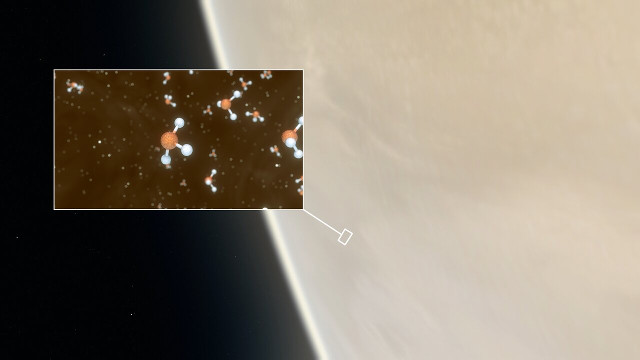
An article published in the journal “Nature Astronomy” reports the discovery of phosphine in the clouds of the planet Venus. A team of researchers led by astrophysicist Jane Greaves of the British University of Cardiff used the James Clerk Maxwell Telescope (JCMT) in Hawaii and the ALMA radio telescope to probe the Venusian atmosphere. The concentration of phosphine detected is about twenty parts per billion, which may seem little, but as far as we know only anaerobic bacteria can produce it in that amount. For this reason, phosphine is considered a biological signature in the study of the atmospheres of exoplanets even if at the moment it’s not possible to completely rule out an abiotic process that can produce phosphine in the conditions of Venus’s atmosphere.
The environmental conditions on Venus are hellish, with surface temperatures averaging just under 500° Celsius, an atmospheric pressure over 90 times higher than that of the Earth’s surface, and a toxic atmospheric composition, since it’s made up of 96% carbon dioxide. For this reason, he has been dubbed the Earth’s evil twin.
Despite these conditions, in recent decades various scientists tried to speculate on possible microorganisms that could live in the upper layers of the Venusian atmosphere, at altitudes between 33 and 60 kilometers, where temperatures are much lower. However, there were no indications that there might actually be life forms, but the discovery of phosphine changes everything.
The first detection of phosphine in Venus’s atmosphere dates back to June 2017, when Jane Greaves noticed phosphine’s spectroscopic signature in observations conducted with the James Clerk Maxwell Telescope (JCMT). In the spectroscopic analyzes of the electromagnetic emissions coming from Venus, the 1.123-millimeter line contained the trace of the presence of phosphine, an absolute surprise. Only in March 2019, it was possible to verify that discovery using the Atacama Large Millimeter/submillimeter Array (ALMA) radio telescope, inaugurated in March 2013 and generally used to examine objects even billions of light-years away but occasionally also very useful to study objects in the cosmic neighborhood. A confirmation of the presence of phosphine was needed, and ALMA brought it to remove any possible doubts.
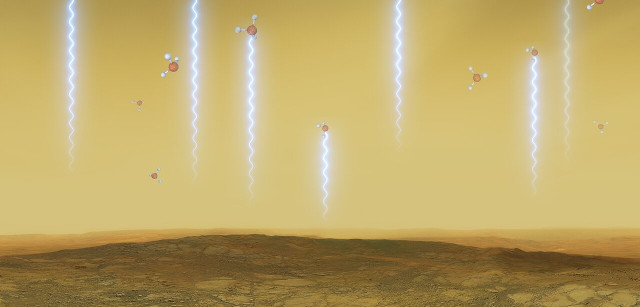
The amount of phosphine detected in Venus’s atmosphere is crucial to understand the importance of this discovery. There could be atmospheric phenomena such as lightning or geological phenomena such as volcanoes capable of generating small amounts of phosphine, but as far as we know in those environmental conditions only anaerobic bacteria or other similar life forms can generate it in the detected amount. In fact, according to the researchers, Earth bacteria could make it even at 10% of their maximum productivity.
The researchers admit the possibility that there are photochemical or geochemical processes unknown to us that allow the generation of all that phosphine under Venus’s conditions. We know that phosphine can form under the conditions that exist in Jupiter’s atmosphere, where the pressure reaches levels much higher than the Venusian ones and great storms provide additional energy. The announcement of the discovery on Venus could spur new research, and that’s important because clues to the existence of extraterrestrial life are something so grandiose that they need strong confirmation or a debunking.
The association of the presence of great amounts of phosphine with life forms is so strong that some scientists proposed in an article published in the journal “Astrobiology” in January 2020 to consider it as a biological signature in the studies of the atmospheres of exoplanets. For the same reason, Jane Greaves and some members of her team wrote another article, also published in “Astrobiology” but in August 2020, in which they try to hypothesize a life cycle in the possible Venusian biosphere.
After the announcement of the presence of phosphine in Venus’s atmosphere, there will certainly be new observations and new studies on the subject also to try to understand how to prove that it was produced by living organisms. For now, this is not a smoking gun. There’s the smell of gunpowder, now they have to check that it wasn’t produced by processes other than firing a gun. The authors of the research themselves are cautious but it’s undoubtedly a very intriguing discovery.

Permalink