An article published in the journal “Astronomy & Astrophysics” reports the results of a research on the five major moons of the planet Uranus. A team of researchers led by Örs H. Detre of the Max Planck Institute for Astronomy (MPIA) in Heidelberg, Germany, analyzed data collected by ESA’s Herschel Space Observatory using a new technique that made it possible to obtain new information from the weak signals obtained in the past to determine the physical characteristics of the moons Titania, Oberon, Umbriel, Ariel, and Miranda. The results indicate that they’re similar to the trans-Neptunian dwarf planets while they’re different from other moons of Uranus leaving open the possibility that they were captured by the planet after their formation.
The Herschel Space Observatory, whose mission lasted from 2009 to 2013, was named after astronomer William Herschel, the discoverer of infrared radiation and the planet Uranus along with its moons Titania and Oberon. It therefore seems appropriate that this space telescope was used to try to obtain more information on those and other major moons of Uranus. Actually, they were only some of the many objects observed using in particular the PACS (Photodetector Array Camera and Spectrometer) instrument, but the planet was used to calibrate the instruments, so it collected a lot of data. Even years after the mission ended, the archive is available for new research, in this case, thanks to a new data analysis technique.
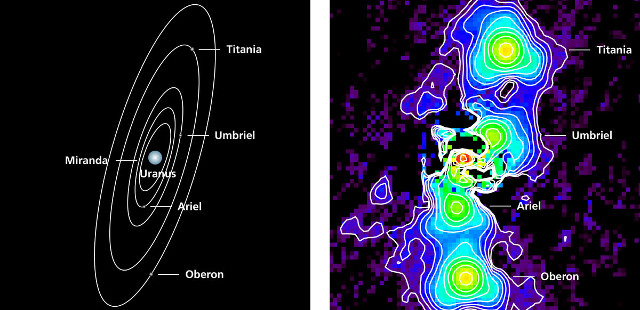
The calibrations used were actually used to evaluate the influence of very bright infrared sources such as Uranus on the PACS instrument’s detector. Discovering the faint signals left by its moons was a coincidence and there was also luck related to their location. The orbital plane of Uranus’ moons is very inclined with respect to their orbit, and their position was favorable during the period of those observations.
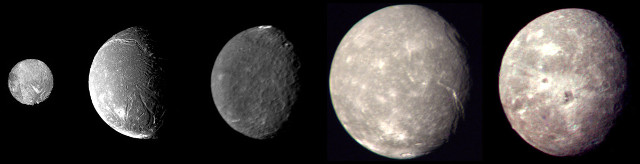
The top image (Courtesy T. Müller (HdA)/Ö. H. Detre et al./MPIA) shows the pattern of the orbits of the main moons of Uranus with their positions on July 12, 2011, when the observations were conducted with Herschel shown in the right pane. The bottom image (Courtesy NASA/JPL/MPIA) shows the moons Miranda, Ariel, Umbriel, Titania, and Oberon as seen by NASA’s Voyager 2 space probe.
The new analysis revealed that the surfaces of Uranus’ moons store heat unexpectedly well and cool relatively slowly. For this reason, scientists believe they’re similar to the dwarf planets in the Kuiper belt such as Pluto. Their chaotic orbits had already led to theorizing that they were captured by Uranus after their formation, their characteristics add clues to this theory.
The new technique used by the researchers is based on the elimination of Uranus’ emissions, a process that could also be applied to other observations to obtain more information about celestial bodies that are obscured by brighter objects. It’s a new way to exploit old observations.