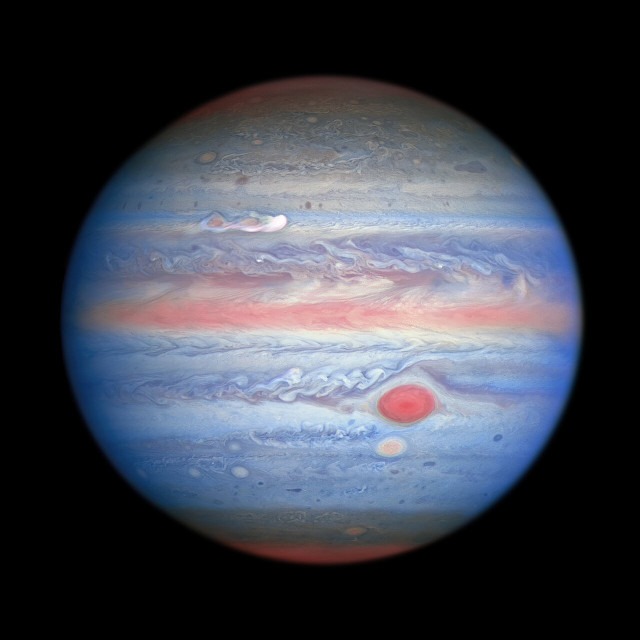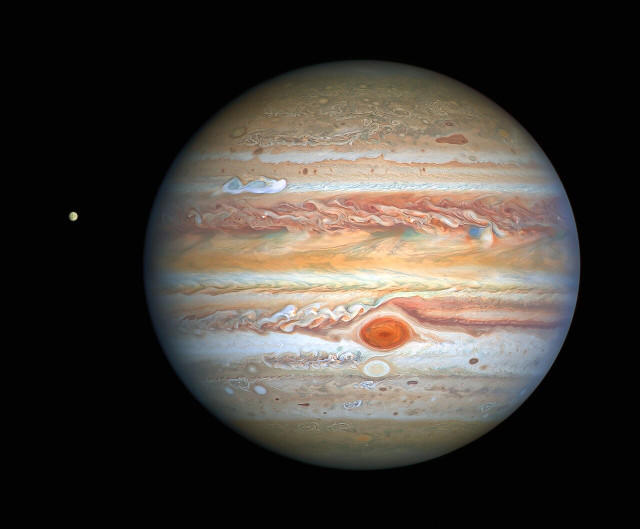
New images of the planet Jupiter captured by the Hubble Space Telescope show the gigantic storms sweeping through it, including a new one in the middle of the Northern Hemisphere that appears as a multiple whitish spot and what was called a cousin of the Great Red Spot because it’s little to south of it has changed color once again. Hubble also captured an image of Jupiter along with Europa, one of its major moons that became famous after the discovery of a subterranean ocean of liquid water in which conditions could be favorable to life.
These new images are part of the Outer Planets Atmospheres Legacy (OPAL) program, which annually provides global views of the outer planets captured by the Hubble Space Telescope. They’re useful to evaluate changes in the atmosphere of these gas planets, which means changes in storms, winds, and clouds.
The images of Jupiter were captured on August 25, 2020, when the planet was “only” 653 million kilometers from Earth. It was the period when Jupiter was in opposition, meaning the period when the Earth was between Jupiter and the Sun. In recent years, NASA had its Juno spacecraft orbiting Jupiter, but it continues to be useful to observe it with other instruments as well such as the Hubble Space Telescope to obtain new images to add to an archive showing the changes in the Jovian atmosphere.
In NASA’s statement, the Hubble Space Telescope was called a weather satellite used to monitor Jupiter’s storms, including the iconic Great Red Spot. Hubble orbits the Earth so the best period for these observations is when Jupiter is in opposition. Every year researchers find something of interest in it, and 2020 was no exception.
On August 18, astronomers spotted a new storm in the mid-northern hemisphere. Initially, it was a single whitish formation, but after a week two more formations appeared of which the one on the right is perhaps still growing. It’s not the first multiple storm observed at those latitudes, but in this case, the timing of the observations conducted with the Hubble Space Telescope is perfect to see its evolution.
A large storm called Oval BA was nicknamed Red Spot Jr. because it formed just south of the famous Great Red Spot in 2000 from the merger of three smaller storms, and turned red in 2006. Over the years its color has changed various times, and now its core has a reddish hue, so it may return to resemble its “cousin”.
Among the images captured by the Hubble Space Telescope, there’s a multiband one that combines observations at ultraviolet, visible, and near-infrared wavelengths. The result gives us a unique view of Jupiter that is useful for astronomers to evaluate the altitude and distribution of hazes and particles in the atmosphere.
These observations are important because they give an updated view of the situation in Jupiter’s atmosphere and were added to those in the large existing archive. The many data that are collected on the largest planet in the solar system help to understand the phenomena taking place, sometimes extreme compared to those typical of the Earth.