Three articles – two of them are available here and here – published in the journal “Nature Astronomy” report the results of as many researches on asteroids Ryugu and Bennu, which are being explored respectively by JAXA’s Hayabusa 2 and NASA’s OSIRIS-REx space probes. The two asteroids already showed some similarities and, in a news & views editorial, Maria Cristina De Sanctis talks about the catastrophic events that might have generated them and the bright rocks discovered on the surface of both despite their dark color. Catastrophic events are also the object of the other two articles, and in the one focused on Bennu, there are indications that some rocks on its surface come from Vesta, one of the largest objects in the asteroid belt between Mars and Jupiter.
For the space missions Hayabusa 2 of the Japanese space agency JAXA and NASA’s OSIRIS-REx, two asteroids with characteristics so to speak primitive and rather similar compositions were chosen. For these reasons, the researchers already expected them to be the result of collisions of larger asteroids with debris that subsequently reaggregated. Similarities such as their shape are more curious. The presence of so-called exogenic materials, fragments from other asteroids, is another point in common between Ryugu and Bennu.
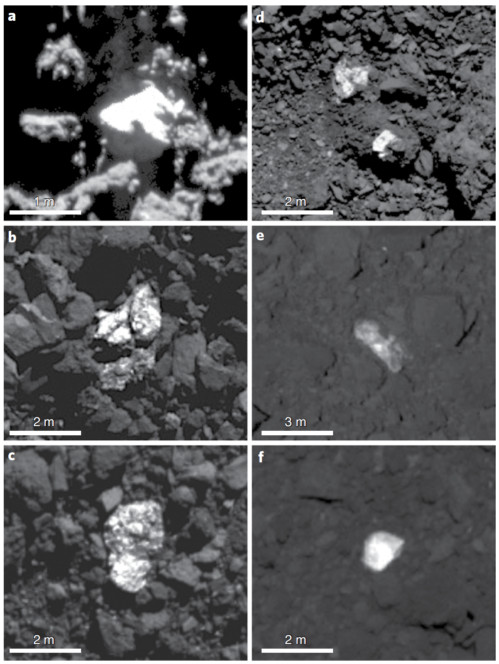
Both asteroids are dark in color, so the presence of much brighter rocks on their surface is noteworthy. It’s no surprise because the first Hayabusa mission found unusual looking rocks on asteroid Itokawa and a similar discovery was made by NASA’s Dawn space probe on the giant asteroid Vesta. According to the authors of the article focused on Bennu, those bright rocks could have arrived from Vesta based on the analyzes carried out by the OSIRIS-REx space probe’s instruments.
The top image (Courtesy Springer Nature Ltd (a, b); Springer Nature Ltd (c, d)) shows bright boulders on asteroid Ryugu in the a and b panels and bright boulders and bright areas on asteroid Bennu surrounded by dark boulders. The bottom image (Courtesy Della Giustina et al., Nature, 2020) shows exogenic materials on the surface of asteroid Bennu.
Giovanni Poggiali of the Italian National Institute of Astrophysics of Arcetri, part of the team that studied those exogenic materials, explained that the data collected indicate that they’re pyroxenes, materials typical of the largest asteroids that have undergone a process of differentiation. NASA’s Dawn space probe’s mission enabled to study Vesta closely and discovered that it’s a protoplanet with a layered structure. Consequently, it’s normal for pyroxenes to be present on Vesta, but definitely not on Bennu. Further analysis established that their composition is very similar to that of the so-called HED meteorites believed to come from Vesta.
The Hayabusa 2 space probe is already on its way to bring back to Earth samples of the asteroid Ryugu that will offer new information on its composition, although it would take a stroke of luck for them to also contain fragments of exogenic materials. Instead, the first attempt to collect samples from the surface of asteroid Bennu by the OSIRIS-REx space probe is scheduled for October 20. Investigations of these asteroids are providing new insights into the chaotic history of the solar system, which has a past where asteroid collisions were likely common.