
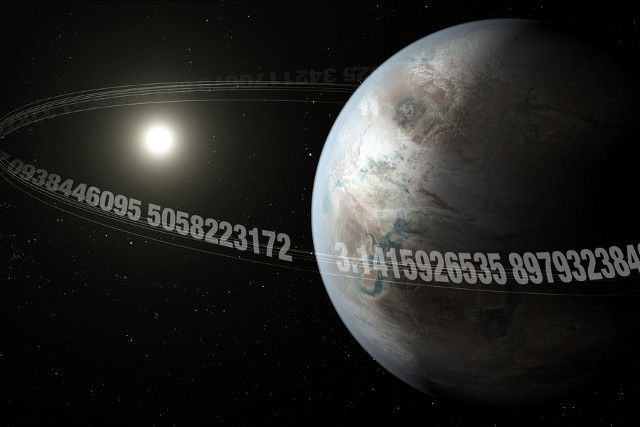
An article published in “The Astronomical Journal” reports a study on the exoplanet K2-315b, nicknamed Pi Earth because its year lasts 3.14 Earth days, an approximation of the value of pi. A team of researchers from the SPECULOOS (Search for habitable Planets EClipsing ULtra-cOOl Stars) project, a network of ground-based telescopes, used them to confirm the planet’s existence by verifying data collected by NASA’s Kepler Space Telescope. Pi Earth is very close to its star so the temperature on its surface is very high even if the star is very small and relatively cold. Any life forms should be analogous to terrestrial extremophiles. It may be lifeless but it is an interesting candidate for studying its atmosphere.
The mission of the Kepler space telescope ended in October 2018 leaving a wealth of data about observations of stars with possible transits of exoplanets in front of them. Follow-up observations carried out with other telescopes verify if those signals were actually left by exoplanets. In the specific case, the star is an ultra-cool dwarf, a tiny star with a mass that is about 17% of the Sun’s, cataloged as EPIC 249631677 or as K2-315 in Kepler’s K2 mission after the identification of a planetary system. An exoplanet candidate was identified in signals indicating the star’s brightness reduction that was repeating every 3.14 days.
Prajwal Niraula of MIT, lead author of the research, and colleagues are members of the team of the SPECULOOS project, which aims to search for habitable planets that orbit ultra-cool dwarf stars, the smallest stars in the universe and very numerous. It’s a type of star that was overlooked in the past, but the discovery of 7 rocky planets around one of them, TRAPPIST-1, has greatly increased the interest in them. SPECULOOS is made up of two observatories, SPECULOOS Southern Observatory (SSO) in Chile and SPECULOOS Northern Observatory (SNO) in Tenerife, consisting of various telescopes.
The researchers checked the signals detected by the Kepler space telescope, ruled out possible alternative explanations for the presence of a planet, and observed the star with the SPECULOOS network’s telescopes. The result was positive, with two detections of the exoplanet with the observatory in Chile and one with Artemis, the latest telescope added to the observatory in Tenerife.
The identified exoplanet, cataloged as K2-315b, is slightly smaller than Earth, so it was nicknamed Pi Earth for the year of 3.14 Earth days, a value that approximates pi. If it had been verified a little earlier, it would have been the 314th planetary system discovered in the K2 mission and not the 315th, and it would have had another number linked to pi!
The exoplanet K2-315b is very close to its star, so, even if it’s relatively cold, the emissions are sufficient to have a temperature on its surface estimated at around 180° Celsius. Of course, a lot depends on the presence of an atmosphere and, if there’s any, of possible clouds that screen the starlight. Due to its proximity, the planet is tidally locked to its star, which means that it always shows it the same face as the Moon does with the Earth. This means that there’s a presumably fiery dayside, a night side that could be freezing, and a twilight zone. Again, much depends on the presence of an atmosphere and how much it transports heat from one area of the planet to another.
Ultra-cool dwarf stars, with their limited brightness, offer an advantage in studying their planets’ atmospheres because the electromagnetic emissions that pass through such atmosphere are not overwhelmed by the brightness that more massive and more active stars have even without flares. This means that the exoplanet K2-315b is an interesting candidate for that kind of follow-up research, not least because at about 185 light-years from Earth it’s practically in the cosmic neighborhood.
Only by having answers regarding the possible atmosphere of the exoplanet K2-315b will scientists be able to make some hypotheses on its potential for habitability. Temperatures on the daytime side could offer conditions that only allow for the existence of life forms similar to Earth’s extremophiles living in places like the hot and acid springs in Yellowstone Park and other places that are prohibitive to almost all other life forms. On the twilight zone and the night side there may be more favorable conditions. In short, it’s an interesting exoplanet which confirms that it’s worth observing the tiny ultra-cool dwarf stars.
