
An article published in “The Astrophysical Journal” reports a study on the data collected during the years of the area around the supermassive black hole at the center of the galaxy M87, the one in the image presented in April 2019 by the Event Horizon Telescope project (EHT) project. A team of researchers led by Maciek Wielgus of the Center for Astrophysics | Harvard & Smithsonian (CfA) also analyzed data not published but was part of the observations carried out between 2009 and 2013 with fewer radio telescopes. Those observations were very useful to show the changes in that area, with the shadow of the black hole M87* wobbling and with a variation in its orientation.
What was called the photo of the century was the result of an extraordinary work that combined the observations conducted with radio telescopes around the world with extremely high precision. They were used as if they were a single instrument in the Event Horizon Telescope (EHT) project, but the great work involved in obtaining the image of M87* took a very long time.
The 2017 observations that led to the creation of that image were conducted in a weeklong window, too short to show significant changes. However, the EHT project began several years ago, and the first observations with fewer radio telescopes began in 2009 and continued as the network of instruments involved has grown. A lot of data never published were archived and, thanks to the accumulated experience, were subsequently analyzed.
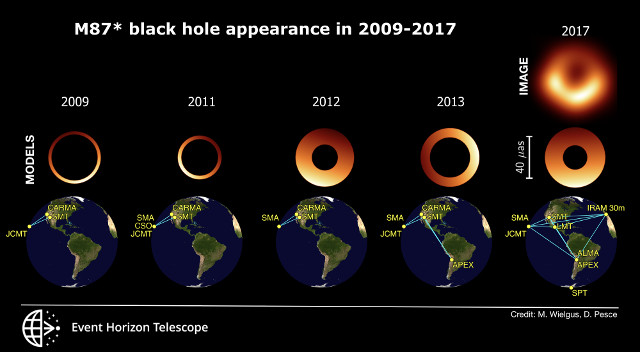
The researchers analyzed M87* data collected with what were called EHT prototypes in 2009, 2011, 2012, and 2013. Those observations didn’t contain enough information to produce images like the extraordinary one presented in April 2019 but still represent a treasure trove useful to evaluate the consistency of the results of statistical modeling techniques used to calculate the changes in the appearance of M87* over time.
The image (Courtesy M. Wielgus, D. Pesce & the EHT Collaboration) shows the appearance of M87* obtained through simulations created using the data obtained from the use of the radio telescopes indicated at the bottom up to the image published in 2019.
The most surprising result of this study was the wobbling of the supermassive black hole’s shadow. The researchers discovered that it’s caused by the turbulent flow of matter falling towards M87*, heating up significantly, and causing the gas to ionize. There are many variations over time and not all the theoretical growth models consider such a strong wobbling. This will allow to test the models and rule out the ones that don’t match the observations.
The observations of M87* are not finished, in fact, in 2018 there was a new campaign with a network that included another radio telescope, and in 2021 a campaign that includes two more observation sites is planned. This will bring more information about this supermassive black hole with more details about a truly extreme object and its changes over time.
This video released by the Event Horizon Telescope project illustrates the behavior of the supermassive black hole M87*.
