September 2020

Views of Enceladus

An article published in the journal “Icarus” reports a study on the frozen crust on the surface of Enceladus, the moon of Saturn which has an ocean of liquid water under its crust. A team of researchers analyzed data collected by the Cassini space probe’s Visible and Infrared Mapping Spectrometer (VIMS) instrument to obtain the most detailed infrared map of Enceladus’s surface. The map shows a clear correlation between reflected infrared emissions and geological activity, and in some areas, the surface ice turns out to be recent.

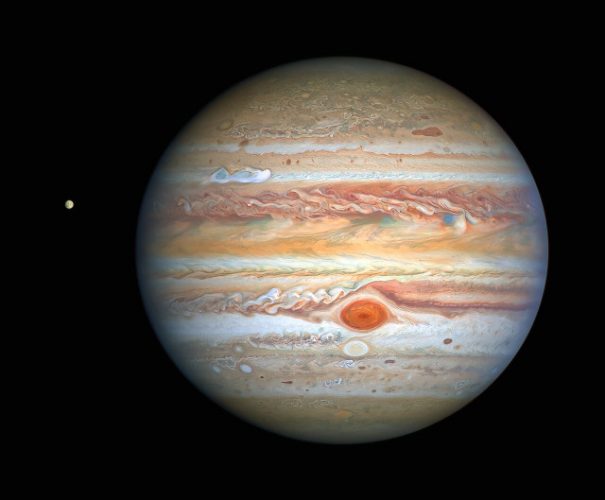
Jupiter and Europa seen by Hubble (Image NASA, ESA, A. Simon (Goddard Space Flight Center), and M. H. Wong (University of California, Berkeley) and the OPAL team.)

New images of the planet Jupiter captured by the Hubble Space Telescope show the gigantic storms sweeping through it, including a new one in the middle of the Northern Hemisphere that appears as a multiple whitish spot and what was called a cousin of the Great Red Spot because it’s little to south of it has changed color once again. Hubble also captured an image of Jupiter along with Europa, one of its major moons that became famous after the discovery of a subterranean ocean of liquid water in which conditions could be favorable to life.

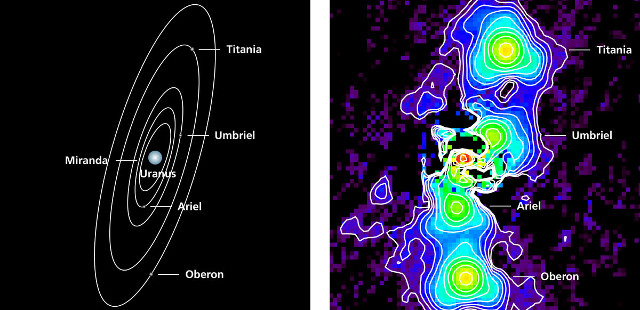
Uranus' moons seen by Herschel

An article published in the journal “Astronomy & Astrophysics” reports the results of a research on the five major moons of the planet Uranus. A team of researchers led by Örs H. Detre of the Max Planck Institute for Astronomy (MPIA) in Heidelberg, Germany, analyzed data collected by ESA’s Herschel Space Observatory using a new technique that made it possible to obtain new information from the weak signals obtained in the past to determine the physical characteristics of the moons Titania, Oberon, Umbriel, Ariel, and Miranda. The results indicate that they’re similar to the trans-Neptunian dwarf planets while they’re different from other moons of Uranus leaving open the possibility that they were captured by the planet after their formation.

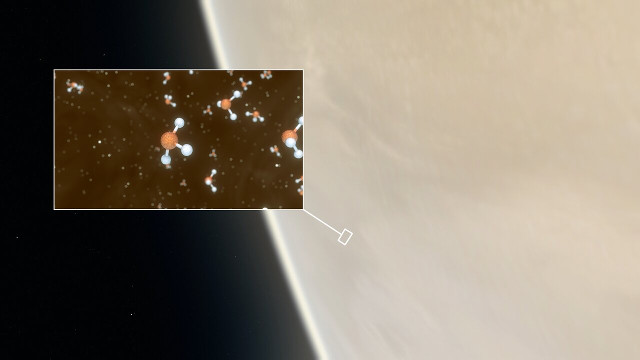
Artistic concept of Venus with the phosphine molecule in the inset (Image ESO/M. Kornmesser/L. Calçada & NASA/JPL/Caltech)

An article published in the journal “Nature Astronomy” reports the discovery of phosphine in the clouds of the planet Venus. A team of researchers led by astrophysicist Jane Greaves of the British University of Cardiff used the James Clerk Maxwell Telescope (JCMT) in Hawaii and the ALMA radio telescope to probe the Venusian atmosphere. The concentration of phosphine detected is about twenty parts per billion, which may seem little, but as far as we know only anaerobic bacteria can produce it in that amount. For this reason, phosphine is considered a biological signature in the study of the atmospheres of exoplanets even if at the moment it’s not possible to completely rule out an abiotic process that can produce phosphine in the conditions of Venus’s atmosphere.

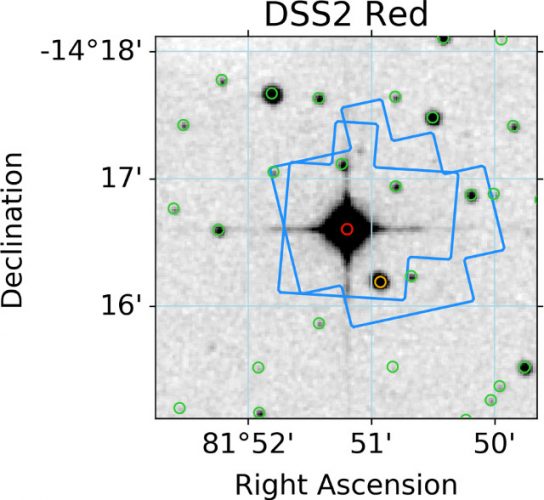
The TOI-421 system, in the DDS2

An article published in “The Astronomical Journal” reports the results of a study of the TOI-421 system, where two exoplanets were discovered following observations conducted by NASA’s TESS space telescope. A team of researchers led by Ilaria Carleo of Wesleyan University used various telescopes to conduct follow-up observations that confirmed the existence of the Neptunian exoplanet detected by TESS also discovering a radial velocity signal that led to the identification of a sub-Neptunian planet. Both are close to their star so they’re heated and their atmosphere is very large with a low density. In particular, the outer exoplanet is of the type that was called super puffy or cotton candy planet, difficult to explain for current models of atmospheric evolution.