September 2020

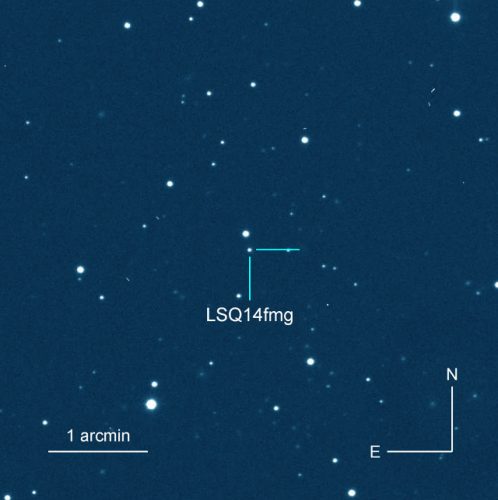
LSQ14fmg (Image courtesy Hsiao et al)

An article published in “The Astrophysical Journal” reports a study on the Type Ia supernova cataloged as LSQ14fmg, which became bright with considerable slowness but at some point became one of the brightest in its class. A team of researchers led by Eric Hsiao of Florida State University used observations conducted with telescopes in Chile and Spain to study its evolution. The conclusion is that the supernova was exploding inside what was an asymptotic giant branch (AGB) star and was caused by the merger of its core with a white dwarf orbiting inside it.

The environment around asteroid Bennu shortly after the ejection occurred on August 28, 2019

A special collection of articles published in “Journal of Geophysical Research: Planets” reports the results of various researches on asteroid Bennu, in some cases already published in recent months. Various researchers used data collected by NASA’s OSIRIS-REx space probe getting some surprises about what happens on Bennu such as the loss of materials being ejected into space. Possible causes include meteoroids, thermal stress, and the ricochet of particles that fall back to the surface then bounce back into space. Bennu’s activity could only be noticed by a nearby space probe, and this raises the question of the possible activity of other asteroids.

Scheme of the CONSERT radar's work

An article published in the journal “Monthly Notices of the Royal Astronomical Society” reports a study indicating that the interior of the nucleus of comet 67P/Churyumov-Gerasimenko is porous and less dense than its surface. A team of researchers reviewed data collected by ESA’s Rosetta space probe and its Philae lander’s CONSERT instrument. The signals exchanged between them through the cometary nucleus propagated at different speeds, indicating a varying density of its interior. This suggests that solar radiation changed the surface, making it less porous.

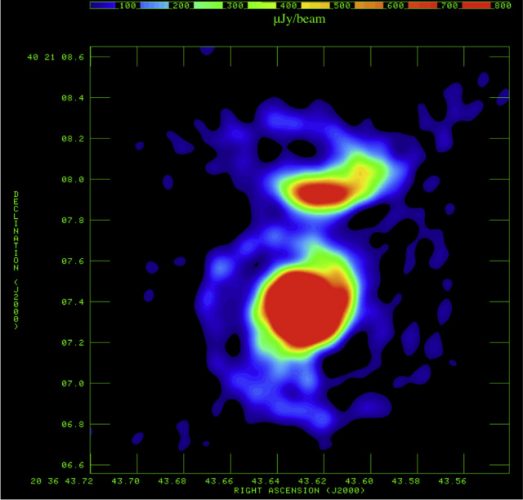
The WR 147 system seen by VLA

An article published in “The Astrophysical Journal Letters” reports a study of the WR 147 system, and in particular of one of the two stars that form it that is now reaching the end of its life, a massive star that is a very hot giant which belongs to the category of Wolf-Rayet stars. A team of researchers used the VLA radio telescope to study the radio emissions from this star, detecting very strong stellar winds colliding with those of its companion, another giant star but not yet at the end of its life. This phenomenon generates very powerful vortices of materials that look like cosmic pinwheels.

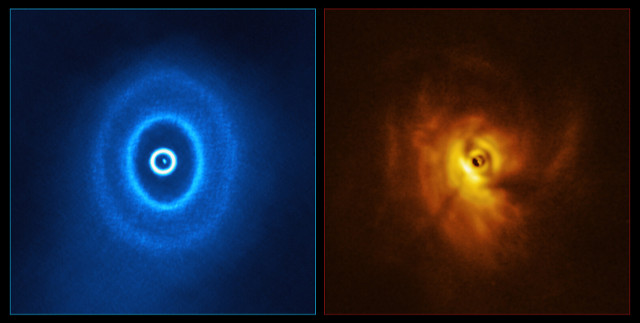
GW Orionis seen by ALMA and SPHERE (Image ALMA (ESO/NAOJ/NRAO), ESO/Exeter/Kraus et al.)

An article published in the journal “Science” reports a research on the characteristics of the circumstellar disk of the GW Orionis system, or GW Ori, warped by the action of the three stars that form it. A team of researchers used the AMBER and later GRAVITY and SPHERE instruments mounted on ESO’s VLTI and the ALMA radio telescope to observe the disk’s twisted shapes and the three rings into which it’s divided, which are misaligned. The innermost ring is made up of an amount of materials estimated to be about 30 times the Earth’s mass, so planets could form. The goal of the studies of this triple system is to understand if planets with stable orbits can form in its rings, a step forward to understand this type of processes in double or multiple systems.