
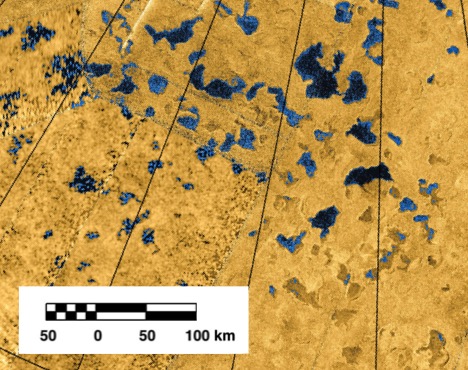
An article published in the journal “The American Astronomical Society” reports a study on the hydrocarbon lakes existing on Titan, the great moon of Saturn, showing its similarities with the Earth’s lakes. A team of researchers led by Jordan Steckloff analyzed data collected by the Cassini space probe and discovered that the lakes of Titan composed of methane, ethane, and nitrogen form layers similar to the ones on Earth. The stratification mechanisms are different because on Earth layers are the consequence of temperature while on Titan they exist because of the particular chemical interactions between the surface liquids and the atmosphere.
The Cassini space probe mission ended on September 15, 2017, but the wealth of data collected continues to be analyzed. From the beginning, Titan was one of the great targets because, despite the very low temperatures, chemical reactions take place that could even allow the development of life forms.
Among the curious similarities between Earth and Titan are stable lakes with a hydrological cycle. The image (NASA/JPL-Caltech/ASI/USGS) shows an area of Titan that is home to various lakes. Of course, on Titan, the hydrological cycle is based on hydrocarbons such as methane and ethane mixed with nitrogen, yet Jordan Steckloff’s team discovered that there’s a stratification in them similar to that of Earth’s lakes. The processes taking place on Titan at temperatures around -183° Celsius are sometimes similar to those taking place on Earth showing that the complex behaviors of liquid surfaces can be controlled by a few simple processes and rules.
Despite the similarities, the researchers also identified the differences between Titan’s lakes and the Earth’s ones, precisely in the causes of the stratification. Earth’s lakes stratify in summer, when the Sun heats the surface of the water causing it to expand and consequently become less dense, forming a layer of warm water that literally floats on the cooler water below. This density-driven layering can also occur on Titan, but it happens due to the amount of atmospheric nitrogen that liquids on Titan’s surface can chemically dissolve.
Liquid methane is less dense than liquid ethane, so scientists believed that methane was the surface layer of lakes on Titan. However, liquid methane has a chemical affinity with atmospheric nitrogen and can dissolve enough of it at the temperatures on that moon to make it denser than ethane. The researchers realized that this behavior would cause lakes to stratify at temperatures a few degrees below those typically found on Titan.
Jordan Steckloff stated that he and his colleagues focused on small shallow lakes that fill up as a result of rains, and found that, if temperatures are low, evaporation of methane from the surface can remove the dissolved nitrogen, which is heavy, bringing an enriched-ethane layer to float on top of a methane-rich layer.
Even at very low temperatures, Titan’s lakes are dynamic, with complex physical processes taking place. They help make this moon curiously similar to Earth. Such an environment favors chemical reactions, which is why so many researchers are interested in studying the possibility that there might even be life forms. Sure, they should be really exotic, but every new research is confirming that Titan is a fascinating place for scientific research of various kinds.
