November 2020

Emissions from 1e1547.0-5408

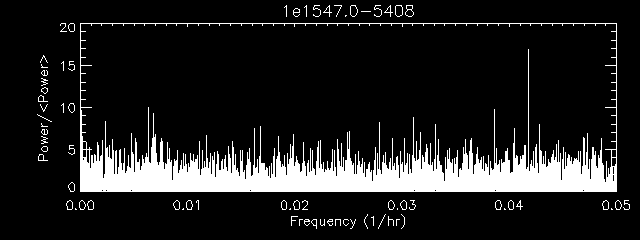
An article accepted for publication in “The Astrophysical Journal” reports a new analysis of observations conducted in 2009 of the magnetar cataloged as 1E1547.0-5408. A team of researchers led by GianLuca Israel of the Italian National Institute of Astrophysics in Rome used data collected by the Parkes radio telescope and NASA’s Chandra and ESA’s XMM-Newton X-ray space observatories to search for emissions from 1E1547.0-5408. The result was the discovery of strong close emissions of X-rays and radio waves that confirm a link between magnetars and fast radio bursts, the focus of recent research.

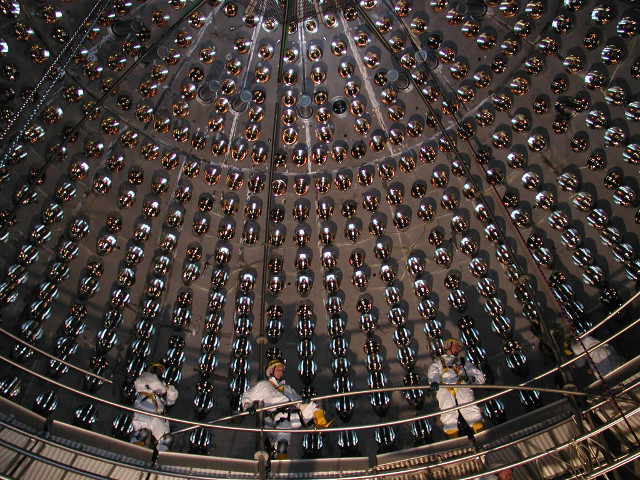
Men at work within the Borexino experiment (Photo courtesy Italian National Institute of Nuclear Physics. All rights reserved)

An article published in the journal “Nature” reports the detection of neutrinos produced by the Sun by the Borexino experiment. The scientists of the Borexino Collaboration at the Gran Sasso National Laboratories of the Italian National Institute of Nuclear Physics that conducted this investigation have thus obtained experimental evidence that the CNO (carbon-nitrogen-oxygen) cycle, which produces those neutrinos, powers the nuclear fusion that occurs in the solar core. This cycle is predominant in stars with a mass greater than the Sun, and this adds importance to the evidence offered to a theory developed more than 80 years ago.

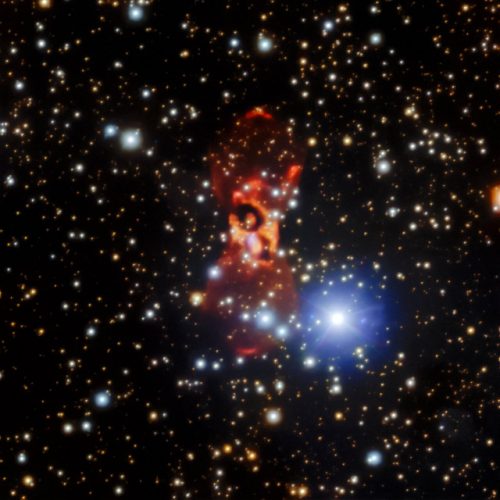
CK Vulpeculae seen with Gemini North (Image International Gemini Observatory/NOIRLab/NSF/AURA. Image processing: Travis Rector (University of Alaska Anchorage), Jen Miller (Gemini Observatory/NSF's NOIRLab), Mahdi Zamani & Davide de Martin)

An article to be published in the “Astrophysical Journal Letters” reports a research on CK Vulpeculae (CK Vul), what was considered a well documented nova having been described between 1670 and 1672, also for the bipolar nebula that left and was recently studied. A team of astronomers led by Dipankar Banerjee, Tom Geballe, and Nye Evans used the GNIRS spectrograph mounted on the Gemini North telescope to obtain measurements that led to the conclusion that CK Vulpeculae is about 10,000 light-years away from Earth, five times as far as previously estimated, and that the explosion was more powerful than a nova but not at the levels of a supernova.

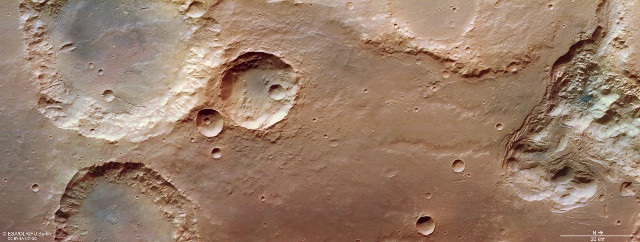
Chaotic terrain in Mars Pyrrhae Regio seen by Mars Express

ESA has released new images captured by its Mars Express space probe’s High Resolution Stereo Camera (HRSC) in Pyrrhae Regio, a region close to the Valles Marineris system on planet Mars. This is what is called chaotic terrain of the kind that forms when there’s underground ice that melts causing large amounts of water to be released. Such a process requires a significant amount of heat, which may have been provided by volcanic activity or a meteor impact. The current look is what is left after the water drained away, leaving in particular the geological formations called mesas.