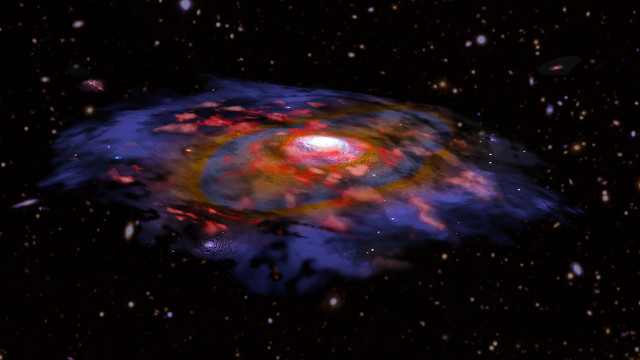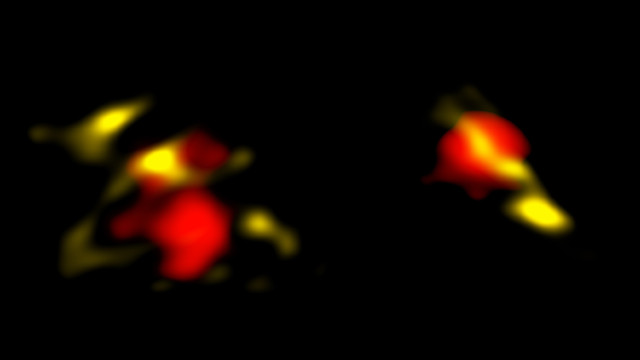
Eight articles – two of them are open access and available here and here – published in the journal “Astronomy & Astrophysics” report as many studies connected to the ALPINE (ALMA Large Program to Investigate C+ at Early Times) project, conducted using the ALMA radio telescope in 70 hours of far infrared observations of 118 galaxies in the early universe. The researchers who conducted the various studies discovered among other things galaxies that are more mature than primordial, in the sense that they contain a significant amount of dust and metals, a situation found in galaxies where many stars were already produced and exploded into supernovae. This is a confirmation that the first cases of galaxies that were already mature when the universe was still young were not isolated.
Many primordial galaxies are obscured by dust that blocks many electromagnetic frequencies. For this reason, the most dusty of them were nicknamed Hubble-dark because the Hubble Space Telescope can’t pick up their emissions even in the deepest images. The ALMA (Atacama Large Millimeter/submillimeter Array) radio telescope, inaugurated in March 2013, can detect some of their emissions in the far infrared.
The ALPINE project showed that observations made with the ALMA radio telescope are important to understand the mechanisms of birth and evolution of galaxies. In fact, it made it possible to discover that there are galaxies in the early universe that have already gone through phases of evolution with the birth and death of many stars in a star-forming activity far superior than what was expected.
The maturity of a galaxy is judged by examining the elements it contains. At birth, a galaxy contains hydrogen and some helium while the heavier elements are formed in stars. Supernovae scatter these elements into space, usually in the form of dust. This means that dusty galaxies that contain heavy elements have already gone through stages of star birth and death. The early dusty galaxies went through this process faster than expected. The ALPINE project identified and studied 118 of them, showing that they’re not isolated.
Carlotta Gruppioni of the Italian National Institute of Astrophysics, Bologna, who participated in this project, explained that the formation rate in the dusty galaxies discovered by the ALPINE project was already very high in the early universe and almost constant for almost three billion years, between 12.8 and 10 billion years ago. The researcher mentioned the star formation peak placed 10 billion years ago by optical and ultraviolet studies, which can’t see the dusty galaxies that were identified by the ALMA radio telescope.
Other space and ground-based telescopes were used for follow-up observations of the galaxies discovered by the ALMA radio telescope. Multi-band observations conducted using different instruments are becoming increasingly important to better understand the processes taking place, in this case in galaxies, which make them glow at different wavelengths. Paolo Cassata, from the University of Padua, Italy, another of the researchers who participated in this project, explained that ultraviolet emissions arrive from many of them despite the dust and this indicates that it’s not distributed evenly. This suggests that they’re still going through their maturation phase.
The published articles are dedicated to the memory of astrophysicist Olivier Le Fèvre, principal investigator of the ALPINE project, who passed away on June 25, 2020. He leaves an important legacy that will be further developed as the researchers intend to conduct more observations with the ALMA radio telescope to understand even better the evolution processes of galaxies.