
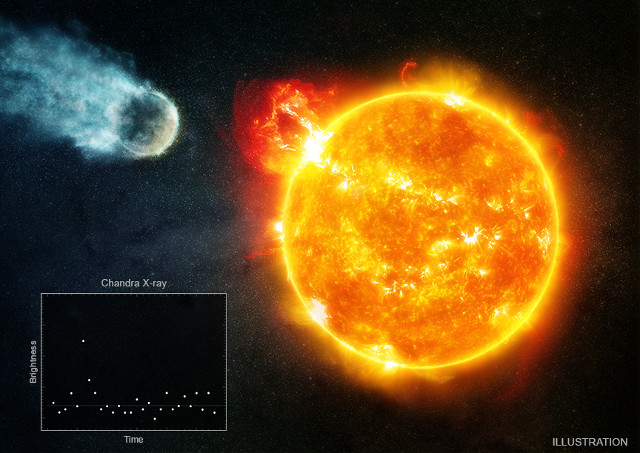
An article published in “The Astronomical Journal” reports a study on the potential impact of the activity of a red dwarf several billion years old such as Barnard’s Star on the potential habitability of its planets. A team of researchers used data collected by NASA’s Chandra X-ray Observatory and the Hubble Space Telescope to keep an eye on Barnard’s Star and its flares observing one X-ray flare in June 2019 and two ultraviolet flares in March 2019. Basically, even if a red dwarf becomes quieter over time, its flares can still erode the atmosphere of a rocky planet.
The discoveries made in recent years about exoplanets orbiting red dwarfs spurred studies on their potential habitability. Red dwarfs are the most numerous stars and consume their hydrogen very slowly, so they have a very long life, consequently many exoplanet searches are focusing on them. The problem is that they’re the smallest stars, but they’re still very active, with flares that can be very violent. A planetary system orbiting a red dwarf with an age similar to the Sun’s or younger tends to be bombarded often by strong electromagnetic radiation that can erode the atmosphere of planets that are originally Earth-like making them Mars-like. What about older red dwarfs?
A team of researchers used Barnard’s Star as a “guinea pig” as it’s a red dwarf with an estimated age of 10 billion years, about twice the age of the Sun, about 6 light years away from Earth, therefore in the cosmic neighborhood. It was studied with the Chandra X-ray Observatory and the Hubble Space Telescope to be able to detect X-ray and ultraviolet emissions during flares. The result was the observation of one X-ray flare in June 2019 and two high-energy ultraviolet flares in March 2019.
The image (X-ray light curve: NASA/CXC/University of Colorado/K. France et al.; Illustration: NASA/CXC/M. Weiss) shows an artistic representation of Barnard’s Star with a rocky planet hit by a flare with an X-ray component whose brightness is shown in the inset.
The researchers are cautious in their conclusions because limited observations led to simplifications in the models. However, what they called XUV flares, meaning X-ray and ultraviolet flares, they observed, lead to deem that even an ancient red dwarf may have activity of sufficient intensity to erode a rocky planet’s atmosphere.
In November 2018, the discovery of a possible super-Earth orbiting Barnard’s Star was announced, so the star’s activity is a problem that’s not just theoretical. This study is a bit descouraging, but red dwarfs are so numerous that the potentially habitable exoplanets could still be billions in the Milky Way alone even if most of them orbited red dwarfs that are too active.
