An article published in “The Astrophysical Journal” reports a study on the kilonova observed on May 22, 2020, and its consequences. It was the merger between two neutron stars that generated a short gamma-ray burst cataloged as GRB 200522A and as a result, produced what from the first analyzes appears to be a magnetar, still a neutron star but of the type characterized by an extremely powerful magnetic field. A team of researchers led by astronomer Wen-fai Fong of Northwestern University in Evanston, Illinois, USA, considered various possible explanations for the observed event, which had an exceptional brightness, and a kilonova that produced a magnetar was the most likely explanation.
Much of our practical knowledge regarding kilonovas comes from the extraordinary observation of the event on August 17, 2017, when both gravitational and electromagnetic waves were detected by a number of instruments around the world in an exceptional scientific collaboration among several different entities that allowed to follow it from the start. However, other scientists had previously analyzed short gamma-ray bursts and other emissions that matched the expected consequences of a kilonova as evidence of their link.
The May 22, 2020, event, which originated in a galaxy about 5.47 billion light-years from Earth, was very bright in infrared, about 12 times brighter than the kilonova of August 17, 2017, and the brightest of the events known as kilonova consequences. In addition to the short gamma-ray burst and infrareds, electromagnetic emissions were detected in other bands, from radio waves to X-rays, which helped to reconstruct their phases and consequences even without detecting gravitational waves.
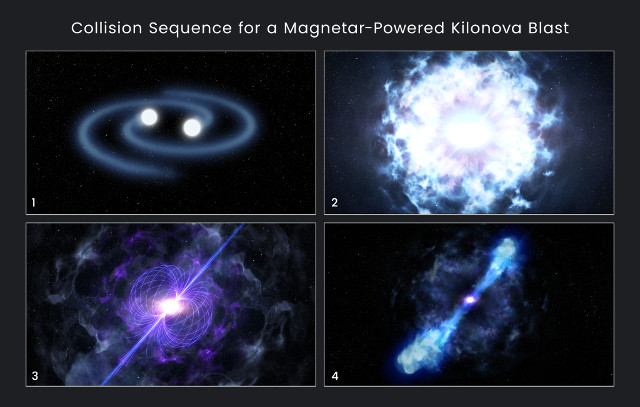
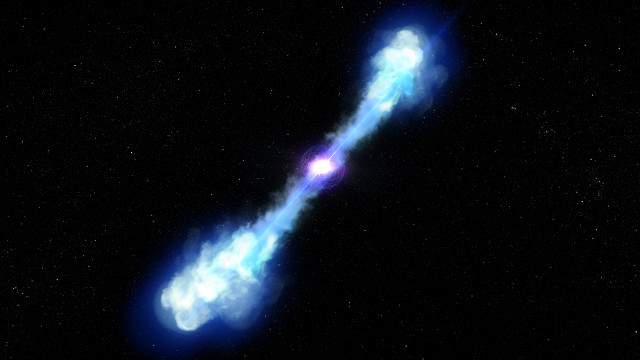
The top image (NASA, ESA, and D. Player (STScI)) shows an artistic illustration of a short gamma-ray burst such as GRB 200522A. The bottom image (NASA, ESA, and D. Player (STScI)) shows the sequence of an event starting from two neutron stars (1) that merge in a kilonova (2) to give birth to a magnetar (3) which emits a short gamma-ray burst (4).
One of the interesting conclusions of this study concerns the kilonova product. It was one of the subjects of discussion since the development of theoretical models concerning neutron star mergers. A black hole seemed to be the most likely product and could be what was generated in the event observed on August 17, 2017. However, the exceptional brightness of the event observed on May 22, 2020, led Wen-fai Fong’s team to conclude that in this case, the product was a magnetar, a type of neutron star with an extremely powerful magnetic field. That’s because from a newborn magnetar high-energy emissions are expected, and therefore a considerable brightness, which follow the gamma-ray burst and are called afterglow in jargon.
Until now, astronomers thought that a magnetar was formed following a supernova, when the remaining neutron star had a particularly powerful magnetic field. This study suggests that the merger of two neutron stars that are not magnetars can also generate a magnetar in some cases. This makes this discovery even more interesting and there will be some follow-up studies, for example, to detect the radio emissions that are expected to arrive in the next few years from the materials ejected from the kilonova. There are also ideas for studies both on kilonovas, to understand the possible differences between different events, and on magnetars, to understand the different processes that could create them.