
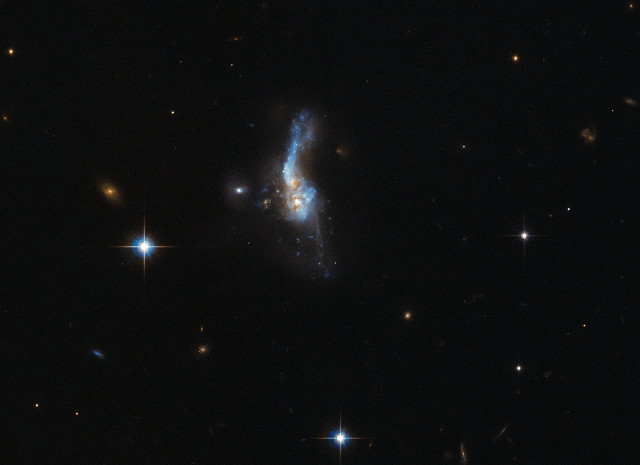
An article published in the journal “Astronomy & Astrophysics” reports a study on hyperluminous galaxies. A team of researchers led by Lingyu Wang of the Netherlands Institute for Space Research, Utrecht, used the LOFAR radio telescope to assess the amount of hyperluminous galaxies in infrared and concluded that it’s ten times higher than what stars can produce according to current models. If the models are correct, it means that in many galaxies there are other light sources such as an active galactic nucleus powered by a supermassive black hole surrounded by large amounts of materials heated to the point of generating electromagnetic emissions.
According to current models, when the universe was young, some primordial galaxies contained a very high amount of gas, to the point of rapidly forming many stars and emitting the light of a trillion suns. Giant stars consume their hydrogen very quickly, so the number of hyperluminous galaxies dropped over time.
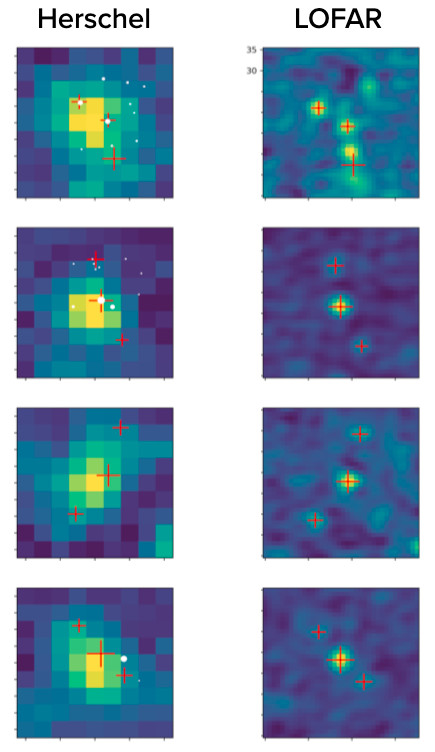
Observations conducted with the Herschel space telescope made it possible to identify hyperluminous infrared sources in both the early universe and more recent eras. The problem is that Herschel’s spatial resolution is not sufficient to distinguish individual galaxies, so the results suggested that there was an excess of hyperluminous sources but were not conclusive.
Lingyu Wang’s team conducted a new study on hyperluminous infrared sources using the LOw Frequency ARray (LOFAR) radio telescope, which has a higher spatial resolution and therefore can distinguish individual galaxies. The bottom image (Courtesy of the Netherlands Institute for Space Research, all rights reserved) shows a group of hyperluminous galaxies seen by Herschel (left) and LOFAR (right).
The observations conducted with the LOFAR radio telescope led to the confirmation of the possibility that there are ten times more hyperluminous sources than those predicted by current models. There’s a possibility that the models contain errors, but the discrepancy is considerable, so the researchers considered other possibilities.
The most likely alternative light source is that from an active galactic nucleus. Even young galaxies have been shown to have supermassive black holes, which can be surrounded by huge amounts of materials that get heated to the point of generating electromagnetic emissions so strong that their galaxies are transformed into the brightest objects in the universe. When a galaxy is full of dust, it can be difficult to recognize the existence of an active galactic nucleus because many electromagnetic frequencies are blocked. The consequence may be that a galaxy with an active galactic nucleus is hyperluminous at infrareds, which pass through dust.
Lingyu Wang, along with W. J. Pearson, a member of his team, had previously participated in another study, also published in “Astronomy & Astrophysics”, which showed how galaxy mergers could generate an active galactic nucleus. In the early universe, galaxy mergers were very common, so it’s possible that active galactic nuclei were also much more numerous than today.
To get more data, the researchers plan to conduct a follow-up study using the Keck Observatory. Its characteristics will allow to obtain more precise data on the distance of the observed galaxies and detections at optical frequencies with spectra. This will help to get more information on the evolution of galaxies.
