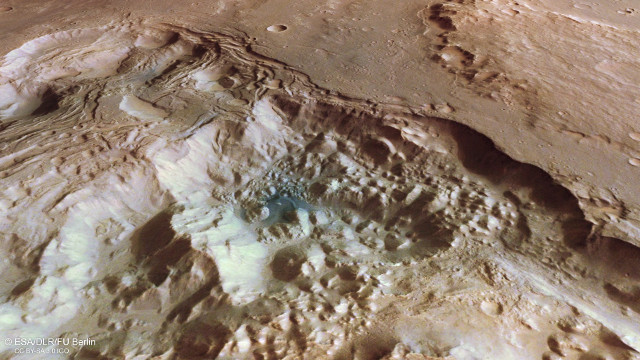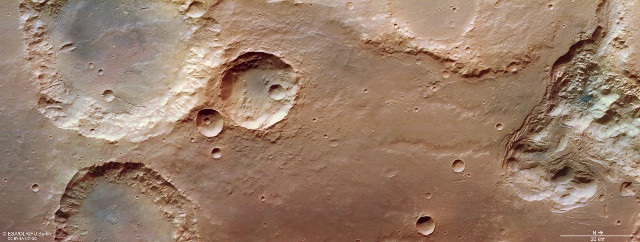
ESA has released new images captured by its Mars Express space probe’s High Resolution Stereo Camera (HRSC) in Pyrrhae Regio, a region close to the Valles Marineris system on planet Mars. This is what is called chaotic terrain of the kind that forms when there’s underground ice that melts causing large amounts of water to be released. Such a process requires a significant amount of heat, which may have been provided by volcanic activity or a meteor impact. The current look is what is left after the water drained away, leaving in particular the geological formations called mesas.
Pyrrhae Regio is located on an ancient plateau covered with craters. Nearby there are traces of ancient rivers and channels that testify to the complex history that dates back to the times when there were large amounts of water on Mars, also in a liquid state. Even after the environmental collapse that caused a planet similar to Earth to become the red planet we know today, water was present in the form of subsurface ice, protected from conditions where it would sublimate.
The Valles Marineris, also near Pyrrhae Regio, are a gigantic canyon system, a kind of huge scar clearly visible also in the images of the entire Mars. They were probably created when intense volcanic activity created a very long crack in the Martian crust. It’s therefore possible that volcanoes also warmed the Pyrrhae Regio area, or meteorite impacts were the culprits. There may also have been a combination of both factors that caused the area’s subsurface ice to melt relatively quickly.
The outflow of water from Pyrrhae Regio left large cavities, and in many areas the ground collapsed. The bottom of those cavities reaches four kilometers below the ground level close to that craters that in the top image (ESA/DLR/FU Berlin, CC BY-SA 3.0 IGO) are visible to the left of the chaotic terrain. The bottom image (ESA/DLR/FU Berlin, CC BY-SA 3.0 IGO) provides a perspective view of the chaotic terrain that gives an idea of its unevenness and irregularities.
Various geological processes may have also occurred relatively recently, which from the point of view of the Mars history means a few hundred million years ago. Many researchers are studying Martian volcanoes to understand when they were active and how they affected the geology of the red planet far beyond Pyrrhae Regio.