
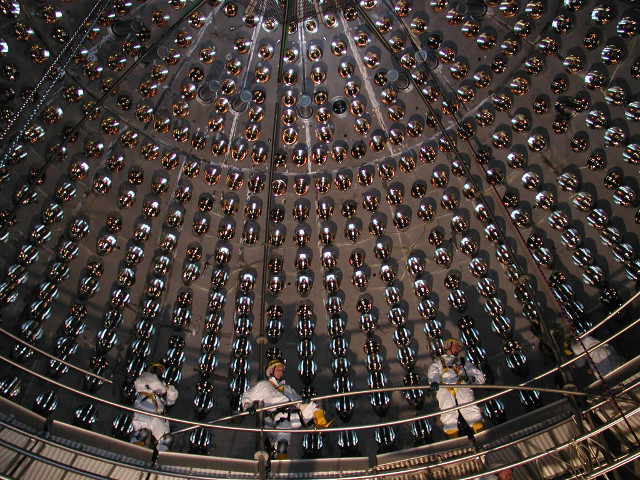
An article published in the journal “Nature” reports the detection of neutrinos produced by the Sun by the Borexino experiment. The scientists of the Borexino Collaboration at the Gran Sasso National Laboratories of the Italian National Institute of Nuclear Physics that conducted this investigation have thus obtained experimental evidence that the CNO (carbon-nitrogen-oxygen) cycle, which produces those neutrinos, powers the nuclear fusion that occurs in the solar core. This cycle is predominant in stars with a mass greater than the Sun, and this adds importance to the evidence offered to a theory developed more than 80 years ago.
The fusion of hydrogen into helium is what makes stars bright during the main phase of their life. This type of nuclear fusion occurs with mechanisms that from a theoretical point of view are well described in what are called the CNO-cycle and proton-proton (pp) chain. The problem is that these processes take place in the nuclei of stars, under conditions of temperature and pressure extremely different from those on Earth. This had made it impossible to find experimental evidence of the CNO-cycle so far. The development of neutrino physics and detectors capable of capturing the rare interactions that occur between neutrinos and matter made it possible to obtain such evidence, but it took decades.
Neutrinos have a really tiny mass and are generated by various reactions that include nuclear fusion that occurs in stars but also radioactive decay. For this reason, in the activity of a neutrino detector it’s necessary to be able to recognize the “noise” generated by the decay of radioactive elements present on Earth, always present even in the best environmental conditions. Neutrinos have different characteristics and from them it’s possible to recognize those generated by the CNO-cycle and the proton-proton chain.
The Borexino experiment, from BOREX (BORon solar neutrino EXperiment), is a project dating back to 1990, and in the course of an activity begun in 2007 it was used for various neutrino physics studies. In the past, it already detected neutrinos coming from the Sun generated by the proton-proton chain, which is the main mechanism of energy production in a star of that type. Now the detection of neutrinos generated by the CNO-cycle proves that this mechanism is also active in the Sun, even if only for 1% of the energy generated. In more massive stars, the CNO-cycle becomes far more important, so this investigation offers new confirmations in particular to the models of their nuclei’s processes.
These experimental confirmations give a great closure to a chapter in the history of physics and astrophysics that began in 1938, when the CNO-cycle was theorized. For decades, only indirect evidence were found, but it was important to get direct findings because scientific studies can always reveal surprises and they bring progress as well.
In addition to direct confirmation of the CNO-cycle in the Sun, the detection of solar neutrinos can also offer information on its metallicity, which means the presence of elements heavier than hydrogen and helium, in the various layers of the Sun. In this case, measurements obtained by spectroscopy and heliosismology gave mixed results. Metallicity in the Sun’s core can only be estimated from the neutrinos it emits.
Even after this study, the Borexino experiment continued to collect data. The operations were expected to be completed by the end of 2020, but could be extended to 2021. All the data that will be added could be useful to learn more about the processes that take place in the heart of the stars, especially the most massive ones.
