
An article accepted for publication in “The Astrophysical Journal” reports a new analysis of observations conducted in 2009 of the magnetar cataloged as 1E1547.0-5408. A team of researchers led by GianLuca Israel of the Italian National Institute of Astrophysics in Rome used data collected by the Parkes radio telescope and NASA’s Chandra and ESA’s XMM-Newton X-ray space observatories to search for emissions from 1E1547.0-5408. The result was the discovery of strong close emissions of X-rays and radio waves that confirm a link between magnetars and fast radio bursts, the focus of recent research.
Evidence of a link between magnetars, neutron stars with a very powerful magnetic field, and fast radio bursts were reported in four articles published in November 2020 in the journal “Nature” concerning the case of the magnetar cataloged as SGR 1935+2154. Such evidence represents an important piece in a cosmic puzzle that in recent years has been the focus of various discussions to try to understand the origin of those bursts. However, in 2009 few fast radio bursts had been detected, and they were typically considered interference from Earth’s sources. Only the greater attention paid in recent years made it possible to ascertain their astronomical origin, and among the consequences there’s also an examination with different eyes of data collected in the past.
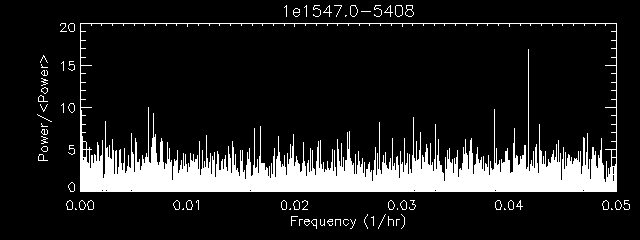
The magnetar 1E1547.0-5408 had already been known for some years for the emission of radio waves in pulses with a period of 2 seconds. In 2009 there was a period of particular intensity with outbursts observed in a multiband campaign that allowed to record a lot of data from radio waves to gamma rays. 1E1547.0-5408 was also observed later, and the image (Courtesy ASM/RXTE team. All rights reserved) shows some emissions.
Reviewing that data in the light of the knowledge accumulated in recent years on fast radio bursts, GianLuca Israel’s team noticed two very intense radio pulses in the Parkes radio telescope’s observations. The first pulse followed by only 1 second an X-ray burst observed by the XMM-Newton observatory and also by two other NASA space telescopes: Swift and Konus-Wind.
Actually, the most powerful radio pulse detected during that observation campaign is much weaker than that emitted by SGR 1935+2154, the magnetar at the center of the study published in “Nature”. This magnetar too emitted radio pulses that were much weaker than the burst that offered evidence of the link between the two of them. In this case, the radio pulses arrived a few milliseconds before the X-ray burst. The difference with respect to the emissions of 1E1547.0-5408 could be significant, but GianLuca Israel stated that comparative studies could only be done with a larger sample of similar events.
It was important to detect these radio and X-ray emissions from magnetars in the Milky Way because this made it easier to collect data in different electromagnetic bands than fast radio bursts from other galaxies. The magnetar 1E1547.0-5408 is approximately 14,670 light years from Earth, making it an excellent target for observations. The ones conducted in 2009 reserved some surprises more than a decade later, reinforcing the idea that at least some of the fast radio bursts are produced by magnetars. However, it also shows a continuity between the intensity of those phenomena and less powerful radio pulses that could sometimes be much closer to those typically emitted by pulsars, another type of neutron star.
Research on the mechanisms that determine the different behaviors of the two types of neutron stars could cross paths with research on fast radio bursts. More research on fast radio bursts and neutron stars is ongoing. State-of-the-art instruments offer new data and, together with the re-examination of old observations, will certainly provide more information on these extreme objects.
