November 2020

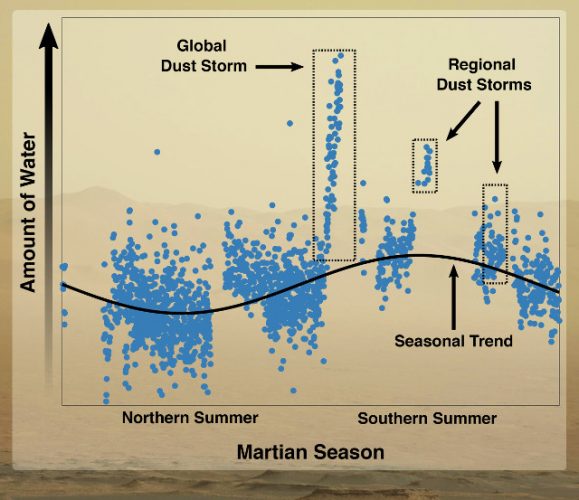
A depiction of water in Mars' atmosphere with peaks during periods of both regional and global dust storms

An article published in the journal “Science” reports a study that explains where most of the water that the planet Mars possessed when it was young, when it was in the liquid state on its surface, has gone. A team of researchers led by Shane Stone of the University of Arizona, USA, used data collected by NASA’s MAVEN space probe to track the movements of water in the atmosphere, up to high altitudes, where there are reactions that break it down and produce atomic hydrogen that is dispersed in space. This study highlighted the role of dust storms in water loss.

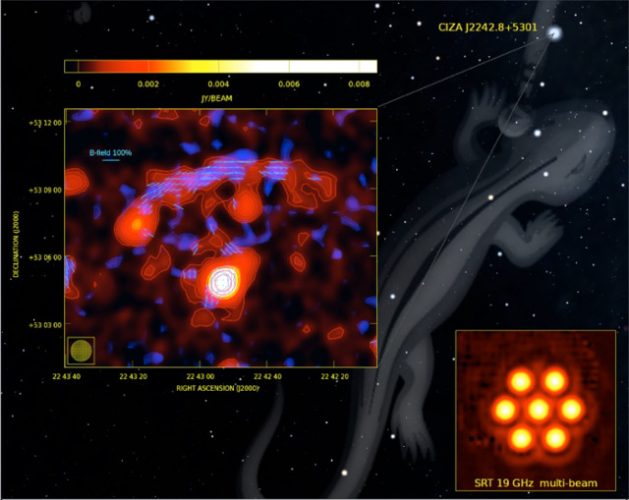
The radio relice in the galaxy cluster CIZA J2242.8+5301

An article published in the journal “Monthly Notices of the Royal Astronomical Society” reports a study on the galaxy cluster CIZA J2242.8+5301. A team of researchers led by astrophysicist Francesca Loi of the Italian National Institute of Astrophysics, Cagliari, used the Sardinia Radio Telescope (SRT) to conduct 240 hours of observations to obtain the highest-frequency spectro-polarimetric image ever produced by a radio telescope of what in jargon is called a radio relic. The quality of the observations enabled to obtain better results than previous studies, which were contradictory, leading to controversy.

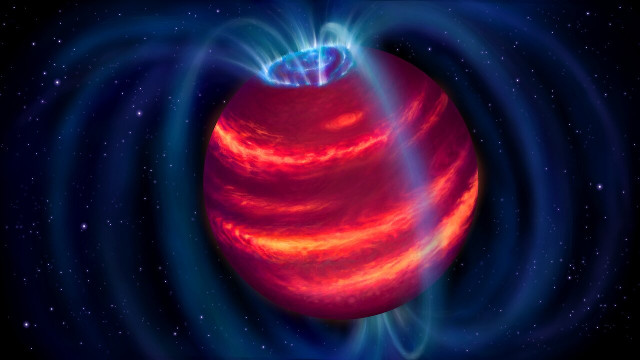
Artist's concept of the brown dwarf BDR J1750+3809 with its magnetic field and aurorae (Image ASTRON/Danielle Futselaar)

An article published in “The Astrophysical Journal Letters” reports the confirmation of the first detection of a brown dwarf through radio observations. This is the result of a collaboration between various entities that led to the use of the LOw Frequency ARray (LOFAR) radio telescope, the Gemini North telescope, and NASA’s InfraRed Telescope Facility (IRTF), both in Hawaii, to discover and characterize the brown dwarf cataloged as BDR J1750+3809. Being able to locate very faint objects with a radio telescope represents a significant advance because it will help to learn more about brown dwarfs and offers the hope of even finding exoplanets ejected from their star systems.

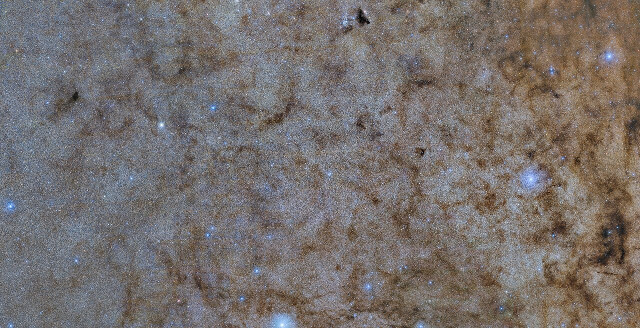
The Milky Way's bulge (Image CTIO/NOIRLab/DOE/NSF/AURA. Image processing: W. Clarkson (UM-Dearborn), C. Johnson (STScI), and M. Rich (UCLA), Travis Rector (University of Alaska Anchorage), Mahdi Zamani & Davide de Martin.)

Two articles published in the journal “Monthly Notices of the Royal Astronomical Society” report different aspects of a research on what is commonly called the bulge, a large group of stars in the central area of ​​the Milky Way. A team of researchers used the Dark Energy Camera (DECam) to conduct observations of the bulge, with its 250 million stars among which in particular the ultraviolet emissions of the ones in the cluster known as red clump were detected because it’s formed by red giants. By analyzing their emissions it was possible to find the spectroscopic traces of the chemical elements inside more than 70,000 stars. The red giants near the center of the Milky Way showed a very similar composition indicating that they formed around the same time, over 10 billion years ago.

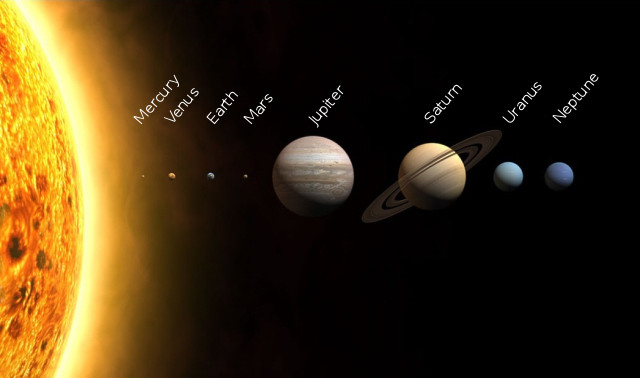
The solar system's planets (Image WP)

An article published in the journal “Icarus” reports a study on the solar system’s structure that offers a reconstruction of its origins. A team of researchers led by Matt Clement of the Carnegie Institution conducted over 6,000 simulations of the solar system’s evolution that led to the conclusion that Jupiter used to make three revolutions around the Sun in the time it took Saturn to make two revolutions when the two planets had just formed. The results also indicate that there was another planet between Saturn and Uranus that was ejected from the solar system, a conclusion that supports a hypothesis that has been studied for years.