November 2020

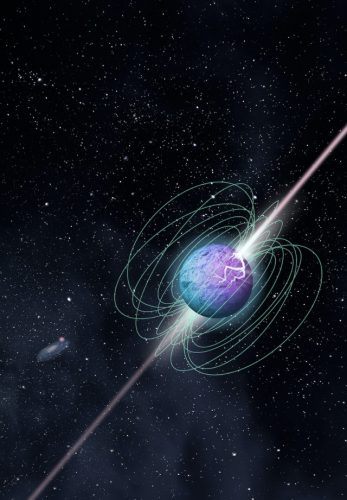
Artist's concept of a magnetar and its magnetic field (Image courtesy McGill University Graphic Design Team)

Four articles published in the journal “Nature” report as many studies connected to a fast radio burst cataloged as FRB 200428, whose origin has been associated with a magnetar cataloged as SGR 1935+2154. The CHIME/FRB collaboration reported the observations conducted with the CHIME radio telescope, the second team of researchers reported the observations conducted with the STARE2 radio telescope, the third team reported the observations conducted with the FAST radio telescope, Bing Zhang of the University of Nevada, USA, published an article on the physical mechanisms of fast radio bursts.

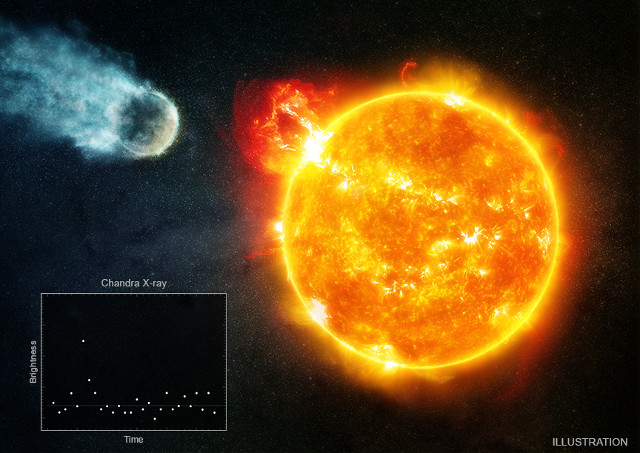
Artistic representation of Barnard's Star with a rocky planet hit by a flare with an X-ray component

An article published in “The Astronomical Journal” reports a study on the potential impact of the activity of a red dwarf several billion years old such as Barnard’s Star on the potential habitability of its planets. A team of researchers used data collected by NASA’s Chandra X-ray Observatory and the Hubble Space Telescope to keep an eye on Barnard’s Star and its flares observing one X-ray flare in June 2019 and two ultraviolet flares in March 2019. Basically, even if a red dwarf becomes quieter over time, its flares can still erode the atmosphere of a rocky planet.

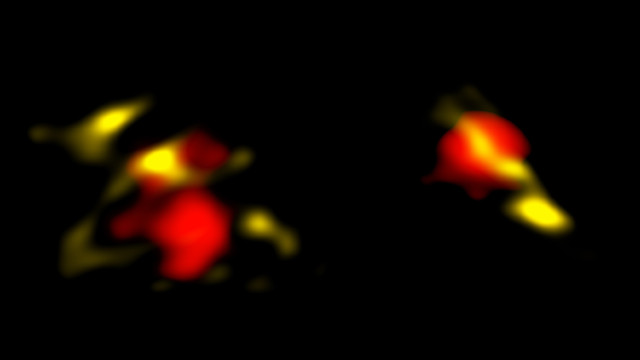
Two dusty galaxies detected by ALMA (Image B. Saxton NRAO/AUI/NSF, ALMA (ESO/NAOJ/NRAO), ALPINE team)

Eight articles published in the journal “Astronomy & Astrophysics” report as many studies connected to the ALPINE (ALMA Large Program to Investigate C+ at Early Times) project, conducted using the ALMA radio telescope in 70 hours of far infrared observations of 118 galaxies in the early universe. The researchers who conducted the various studies discovered among other things galaxies that are more mature than primordial, in the sense that they contain a significant amount of dust and metals, a situation found in galaxies where many stars were already produced and exploded into supernovae. This is a confirmation that the first cases of galaxies that were already mature when the universe was still young were not isolated.