
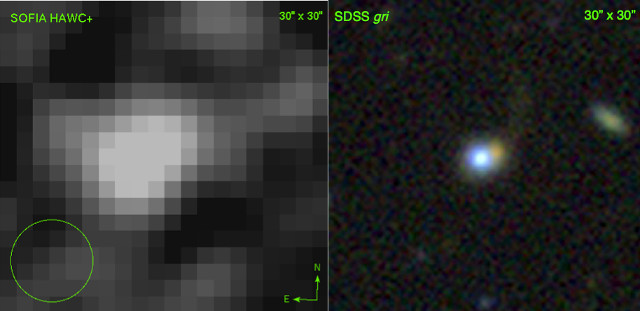
An article published in “The Astrophysical Journal” reports a study on the galaxy CQ 4479, where a quasar was observed, an active galactic nucleus with a supermassive black hole that is devouring large amounts of matter, and at the same time an intense star formation. A team of researchers used the SOFIA flying telescope to observe CQ 4479, and found this situation called a cold quasar because the active galactic nucleus is very hot but the galaxy also contains cold gas that gives birth to new stars. This is a rare case that could show an astronomically short period in the evolution of a galaxy before the quasar starts inhibiting star formation.
Quasars are active galactic nuclei powered by a supermassive black hole surrounded by huge amounts of gas and dust that get heated to the point of generating strong electromagnetic emissions that make them the brightest objects in the universe. According to the models, this activity interferes with star formation by devouring gas and also generating a magnetic field that causes the ejection of jets of highly-energy materials that reduces the presence of the cold gas necessary for star formation.
In essence, quasars suffocate the galaxies that host them or so it’s supposed to happen, but last year, at the 234th meeting of the American Astronomical Society, held in St. Louis, Missouri, USA, there was the announcement of the discovery of what were called cold quasars because in the galaxies that host them there’s still an abundance of cold gas that allows the continuation of star formation.
Allison Kirkpatrick of the University of Kansas led the team that discovered cold quasars and is part of the team that studied galaxy CQ 4479. The researcher compared CQ 4479’s moment in life to a midlife crisis. That’s because it’s going through a last moment of intense stellar activity while the quasar that is about to kill it is about to kick in.
The SOFIA (Stratospheric Observatory for Infrared Astronomy) flying telescope allowed the researchers to examine a cold quasar in detail for the first time by directly measuring the growth of the supermassive black hole, the star formation rate, and the amount of cold gas available to continue star formation. This was achieved by detecting infrared emissions from the heated dust from the star formation process. This approach allowed them to observe what happens around the active galactic nucleus despite its extraordinary brightness, which makes it difficult to observe the rest of the galaxy.
The image (Courtesy Cooke, et. Al. All rights reserved) shows on the left an observation of the galaxy CQ 4479 conducted with the SOFIA flying telescope and on the right a composition created from observations of the galaxy CQ 4479 conducted during the SDSS survey.
To check if the galaxy CQ 4479 is indeed in the early stages of its death, it will be necessary to examine other cold quasars to gather more information. CQ 4479 also requires more study and the researchers mentioned the ALMA radio telescope as an instruments that could provide valuable information and the James Webb Space Telescope when, at last, it gets launched. Cold quasars can represent a phase in the life of certain galaxies, and studying them will help to better understand their evolution and possible death.
