
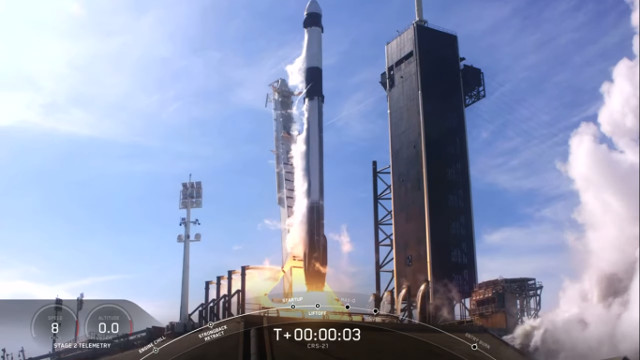
A little while ago the SpaceX Dragon 2 spacecraft blasted off atop a Falcon 9 rocket from Cape Canaveral in its CRS-21 (Cargo Resupply Service 21) mission, also referred to as SPX-21. After just over eleven minutes it separated successfully from the rocket’s last stage and went en route. This is the 21st mission for the Dragon spacecraft to resupply the International Space Station with various cargoes and then return to Earth, again with various cargoes. It’s the first mission for this Dragon version.
The Dragon 2 spacecraft’s cargo is a little almost 3,000 kg (a little more than 6,500 lbs) between the pressurized and the non pressurized section. There are about 364 kg (a little more than 800 lbs) of food and other supplies for the International Space Station crew but most of the cargo consists of instruments, hardware and various other materials needed to science experiments and research conducted aboard the Station.
There are several medical experiments including: Cardinal Heart to study the changes gravity causes in cardiovascular cells, HemoCue to test a device that should provide accurate astronaut white blood cell count in microgravity, Effect of Microgravity on Human Brain Organoids to study the responses to the microgravity of masses of neurons produced in vitro.
ESA’s BioAsteroid experiment will examine the effects of microgravity on mineral breakdown processes by bacteria of the type commonly called the miner microbe. The idea is to look for ways to use these bacteria on space objects to extract minerals useful for space missions.
The Dragon 2 also carries the Bishop of Nanoracks module. This is an airlock system that will increase the possibility of launching nanosatellites but also to mount other types of tools outside the Station and to eject garbage. It can be used for tasks in the Station since it can also accommodate tools useful for the crew and for commercial activities such as those connected to the launch of nanosatellites.
Now the Dragon cargo spacecraft is en route to the International Space Station and everything proceeds normally. The first stage of the Falcon 9 rocket is the same one used for SpaceX’s first astronaut launch at the end of May. Meanwhile, it was used for two more launches. It successfully landed again, in this case on the “Of Course I Still Love You” drone ship.
The arrival is scheduled for Monday: at about 18.30 UTC, the Dragon is scheduled to dock with the Station: the maneuver is automatic as, unlike the first Dragon version, the new one doesn’t need to be captured by the Station’s robotic arm to complete the docking.
