

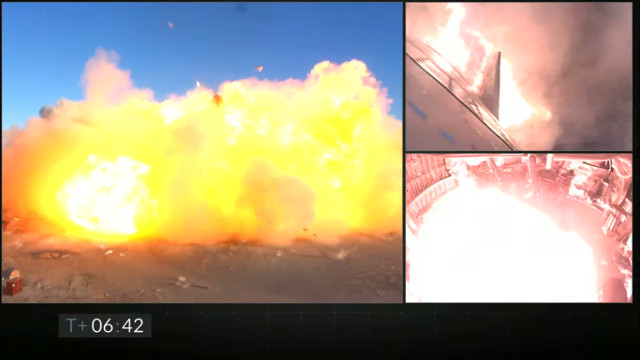
It was afternoon in the USA when SpaceX conducted the first flight test of a prototype of Starship, the one identified as SN8, in Boca Chica, Texas. Equipped with 3 Raptor engines, SN8 flew regularly up to an altitude of approximately 12.5 kilometers, then attempted a controlled landing at the end of a series of maneuvers. During the ascent it remained in a vertical position while during the descent it carried out various maneuvers that brought it to a horizontal position almost to the ground, where it turned over. However, after 6 minutes and 42 seconds of flight, SN8 landed too fast and was consequently destroyed. Despite the ending, the test was in many ways really positive.
Starship is the new spacecraft being developed by SpaceX, which will be coupled with the SuperHeavy, the new rocket also under development and already known as BFR in an earlier phase of the project. Starship can lift off even without SuperHeavy thanks to the new Raptor methane engines. The BF8 prototype was equipped with 3 Raptor engines for the first real flight after two previous prototypes had only made a “hop” up to about 150 meters of altitude.
A real flight, even if with strong altitude limits compared to a mission, can provide valuable information on the performance of the engines, the aerodynamics, and on the performance of various systems such as the landing system. The maneuvers that brought the SN8 prototype into a horizontal position for most of its descent and then flip back to vertical almost at the last moment are completely new for a spacecraft of that size, larger than the Falcon 9 rocket’s first stage.
Most of the test went very well. The vertical rise was followed by maneuvers that led the SN8 prototype to fall with its engines off in a controlled manner, maintaining the trajectory towards the landing area. The problem came at the end, when SN8 flipped and the engines restarted. In the hours following the test, various comments arrived from Elon Musk, who revealed that a low pressure in the fuel tank during the landing burn caused the arrival at high speed and the resulting crash.
Problems were expected as it was the first flight. Starship is very different from the Falcon 9 rocket in size and new engines. The experience accumulated over the past years is crucial, but the solutions to be applied to a new spacecraft must be developed tailoring them to its characteristics.
The maneuverability showed by the SN8 prototype is remarkable. Other prototypes are in various stages of construction, and the SN9 should be nearly complete. The data collected in yesterday’s test will be analyzed to troubleshoot and proceed with a new test. The controlled landing of a Falcon 9 rocket’s first stage was successful after some attempts. SpaceX’s plan is to achieve this kind of success with SuperHeavy and Starship already during their development.
This is SpaceX’s official video of yesterday’s test.

Permalink