2020

Artist's concept of tidal disruption event (Image ESO/M. Kornmesser)

An article published in the journal “Monthly Notices of the Royal Astronomical Society” reports a study on a tidal disruption event cataloged as AT2019qiz in which it was possible to see the phases in which a star was destroyed by a supermassive black hole. A team of researchers led by astrophysicist Matt Nicholl from the British University of Birmingham used various telescopes including ESO’s Very Large Telescope (VLT) and New Technology Telescope (NTT) and NASA’s Spitzer space observatory to follow this event, which lasted about six months, with the star’s “spaghettification” and about half of it swallowed by the black hole.

Artistic representation of the newborn black hole which has a distorted shape with a cusp along with the emissions of gravitational waves

An article published in the journal “Communications Physics” reports a study on black hole mergers that shows the relationship between the gravitational signal emitted by that event and the shape of the black hole produced by it. A team of researchers led by Juan Calderón Bustillo – Marie Curie Fellow of the Galician Institute of High Energy Physics in Santiago de Compostela, Spain, created computer simulations of these mergers establishing that the shape of the black hole produced, distorted during the moments while it’s settling and similar to a chestnut, influence the characteristics of gravitational waves. The “chirps”, as the multiple frequency peaks produced in the gravitational emissions, could be detected if the line of sight were parallel to the merger’s orbital plane.

Some of the galaxies observed in the GAMA project

An article published in the journal “Monthly Notices of the Royal Astronomical Society” proposes a new way of studying star formation in galaxies. A team of researchers led by Sabine Bellstedt of the International Center for Radio Astronomy Research (ICRAR) developed a technique to analyze the metallicity, which is the abundance of elements heavier than helium, of galaxies. Those elements are produced by stars so their amount increases over time and the more massive ones produce more as well as emit more light. By combining the analysis of metallicity with that of the brightness of galaxies it offers information on the masses of stars. The resulting model offers information on the history of star formation, and the application to a sample of 7,000 galaxies indicates that most stars formed in the first 4 billion years of the universe’s life.

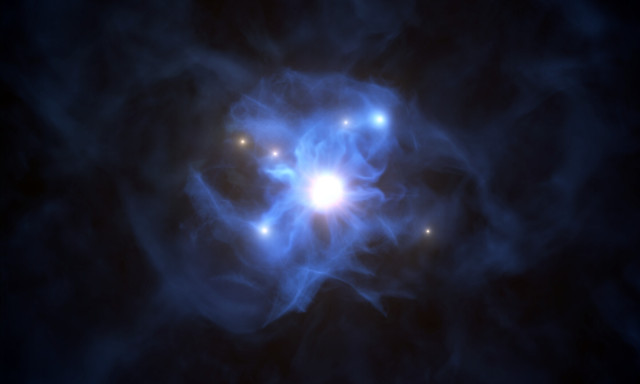
Artist's concept of a supermassive black hole surrounded by galaxies within a cosmic web (Image ESO/L. Calçada)

An article published in the journal “Astronomy & Astrophysics Letters” reports a study on a group of six galaxies surrounding a supermassive black hole which date back to an early epoch when the universe was less than a billion years old. A team of researchers led by Marco Mignoli of the Italian National Institute of Astrophysics (INAF), Bologna, used ESO’s Very Large Telescope (VLT) and the Large Binocular Telescope (LBT) to observe that structure which turned out to be complex as it includes filaments of matter that extend for a distance over 300 times the size of the Milky Way. The gas that concentrates in that structure forms what have been likened to the threads of a spider’s web, and that gas could be responsible for the development of a supermassive black hole in such a remote time.