2020

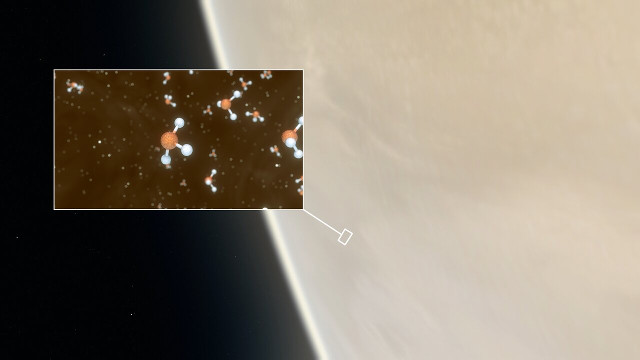
Artistic concept of Venus with the phosphine molecule in the inset (Image ESO/M. Kornmesser/L. Calçada & NASA/JPL/Caltech)

An article published in the journal “Nature Astronomy” reports the discovery of phosphine in the clouds of the planet Venus. A team of researchers led by astrophysicist Jane Greaves of the British University of Cardiff used the James Clerk Maxwell Telescope (JCMT) in Hawaii and the ALMA radio telescope to probe the Venusian atmosphere. The concentration of phosphine detected is about twenty parts per billion, which may seem little, but as far as we know only anaerobic bacteria can produce it in that amount. For this reason, phosphine is considered a biological signature in the study of the atmospheres of exoplanets even if at the moment it’s not possible to completely rule out an abiotic process that can produce phosphine in the conditions of Venus’s atmosphere.

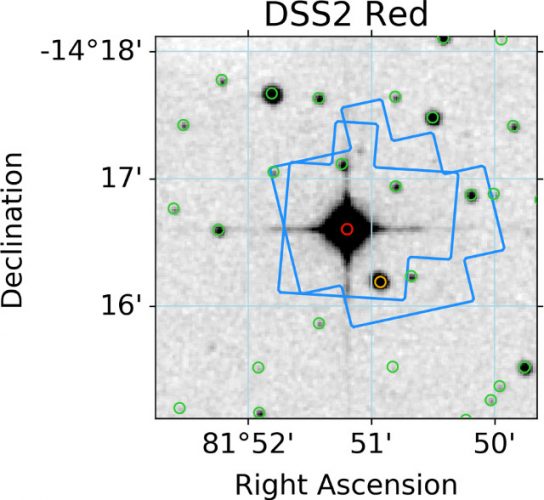
The TOI-421 system, in the DDS2

An article published in “The Astronomical Journal” reports the results of a study of the TOI-421 system, where two exoplanets were discovered following observations conducted by NASA’s TESS space telescope. A team of researchers led by Ilaria Carleo of Wesleyan University used various telescopes to conduct follow-up observations that confirmed the existence of the Neptunian exoplanet detected by TESS also discovering a radial velocity signal that led to the identification of a sub-Neptunian planet. Both are close to their star so they’re heated and their atmosphere is very large with a low density. In particular, the outer exoplanet is of the type that was called super puffy or cotton candy planet, difficult to explain for current models of atmospheric evolution.

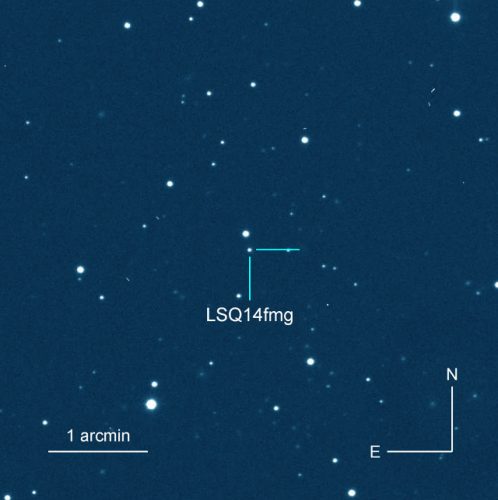
LSQ14fmg (Image courtesy Hsiao et al)

An article published in “The Astrophysical Journal” reports a study on the Type Ia supernova cataloged as LSQ14fmg, which became bright with considerable slowness but at some point became one of the brightest in its class. A team of researchers led by Eric Hsiao of Florida State University used observations conducted with telescopes in Chile and Spain to study its evolution. The conclusion is that the supernova was exploding inside what was an asymptotic giant branch (AGB) star and was caused by the merger of its core with a white dwarf orbiting inside it.

The environment around asteroid Bennu shortly after the ejection occurred on August 28, 2019

A special collection of articles published in “Journal of Geophysical Research: Planets” reports the results of various researches on asteroid Bennu, in some cases already published in recent months. Various researchers used data collected by NASA’s OSIRIS-REx space probe getting some surprises about what happens on Bennu such as the loss of materials being ejected into space. Possible causes include meteoroids, thermal stress, and the ricochet of particles that fall back to the surface then bounce back into space. Bennu’s activity could only be noticed by a nearby space probe, and this raises the question of the possible activity of other asteroids.

Scheme of the CONSERT radar's work

An article published in the journal “Monthly Notices of the Royal Astronomical Society” reports a study indicating that the interior of the nucleus of comet 67P/Churyumov-Gerasimenko is porous and less dense than its surface. A team of researchers reviewed data collected by ESA’s Rosetta space probe and its Philae lander’s CONSERT instrument. The signals exchanged between them through the cometary nucleus propagated at different speeds, indicating a varying density of its interior. This suggests that solar radiation changed the surface, making it less porous.