2020

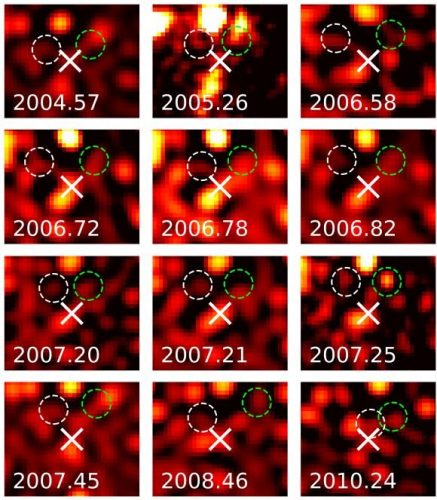
The star S4711 (Image courtesy Florian Peißker et al.)

Two articles published in “The Astrophysical Journal” report research on stars orbiting Sagittarius A*, or simply Sgr A*, the supermassive black hole at the center of the Milky Way, including the ones that reach the highest speed, S62 and S4714, and the one that goes through the orbit in the shortest time, S4711 in 7.6 Earth years. A team of researchers from the German University of Cologne led by Florian Peißker used observations made with the NACO and SINFONI instruments mounted on ESO’s VLT in Chile to track S62’s orbit. With the addition of two more researchers, the team also tracked the orbits of other stars in that area.

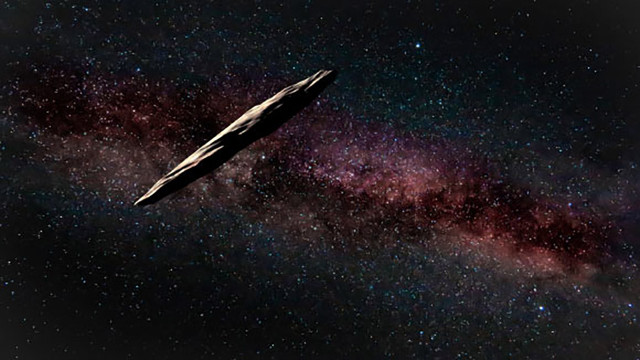
Artist's concept of the interstellar asteroid 'Oumuamua (Image courtesy The international Gemini Observatory/NOIRLab/NSF/AURA artwork by J. Pollard)

An article published in “The Astrophysical Journal Letters” reports a study on the interstellar asteroid 1I/2017 U1, known as ‘Oumuamua, that offers evidence that it’s not some sort of hydrogen iceberg. Abraham Loeb of the Center for Astrophysics | Harvard & Smithsonian (CfA) and Thiem Hoang of the Korea Astronomy and Space Science Institute (KASI) examined the premise of the study that proposed that possibility, that an object composed mostly of molecular hydrogen could form within a giant molecular cloud and be pushed in interstellar space. The researchers concluded that various processes would cause the sublimation of molecular hydrogen, so an iceberg probably couldn’t be formed or would be destroyed by the stars that formed in the same molecular cloud before it could even end up in interstellar space.

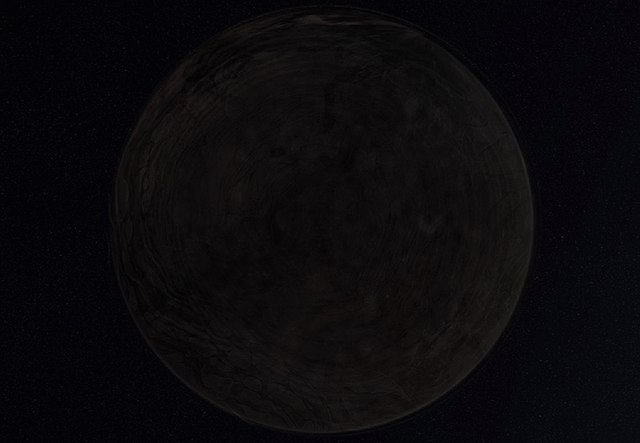
Artist's concept of black dwarf star (Image Baperookamo)

An article published in the journal “Monthly Notices of the Royal Astronomical Society” reports a research on the possibility that in a very distant future, estimated in 10^1100 years, even black dwarfs might explode in supernovae. Matt Caplan of the University of Illinois studied the models of white dwarf evolution as they will keep on cooling while pycnonuclear reactions, which occur at low temperatures but very high density, will generate iron-56. In quite a long time, even elementary particles will start decaying, and this will cause the explosion of the most massive black dwarfs, with masses between 1.2 and 1.4 times the Sun’s. It could be the last significant natural event in the universe.

Betelgeuse seen by Hubble (Image Andrea Dupree (Harvard-Smithsonian CfA), Ronald Gilliland (STScI), NASA and ESA)

An article published in “The Astrophysical Journal” reports a study on the star Betelgeuse’s dimming that occurred between the end of 2019 and the first quarter of 2020 that had suggested that its supernova explosion was imminent. A team of researchers led by Andrea Dupree of the Center for Astrophysics at Harvard and Smithsonian used the Hubble Space Telescope with ultraviolet observations to find traces of a gigantic mass of hot plasma that rose from Betelgeuse’s surface. That plasma moved away, cooling and turning into dust that covered the star’s surface, reducing its brightness to a third of normal.

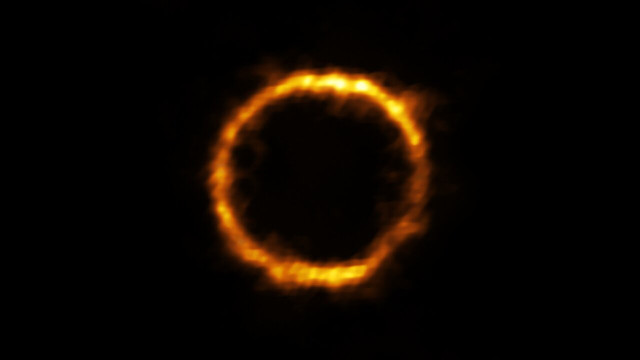
The galaxy SPT0418-47 (Image ALMA (ESO/NAOJ/NRAO), Rizzo et al.)

An article published in the journal “Nature” reports the study of a primordial galaxy we see as it was when the universe was 1.4 billion years old and resembles the Milky Way, a surprise because we see it when it was very young, and according to current theories should be turbulent and unstable. A team of researchers led by Francesca Rizzo, a Ph.D. student at the Max Planck Institute for Astrophysics in Germany, used the ALMA radio telescope to observe this galaxy, cataloged as SPT-S J041839-4751.9, or simply SPT0418-47. Help came from a gravitational lens that magnified the image, allowing to see the similarities with the Milky Way and gather new information on the early stages of galaxy evolution.