2020

Artistic representation of an extreme horizontal branch star with a giant star spot

An article published in the journal “Nature Astronomy” reports a study on stars of a particular type since they’re much smaller than the Sun but much hotter and therefore blue. A team of researchers led by Yazan Al Momany of the Italian National Institute of Astrophysics, Padua, used various instruments on ESO’s Very Large Telescope (VLT) and NTT (New Technology Telescope) in Chile to study stars of that type discovering the equivalent of sunspots but even three thousand times larger in size. In some of these spots, flares have been observed that are millions of times more intense than the Sun’s which indicate the presence of very intense magnetic fields.

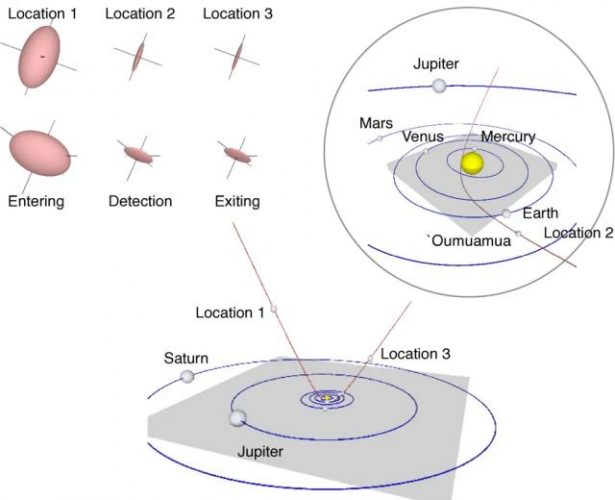
A diagram of the evolution of the interstellar asteroid 'Oumuamua's size and shape

An article accepted for publication in the “Astrophysical Journal Letters” reports a study on the interstellar asteroid 1I/2017 U1 / ‘Oumuamua that offers an explanation for its strange properties. Professor Gregory Laughlin of the University of Yale and Dr. Darryl Seligman of the University of Chicago examined the data collected during the various observations of ‘Oumuamua concluding that it could contain a significant percentage of hydrogen ice and could have originated in the heart of a molecular cloud.

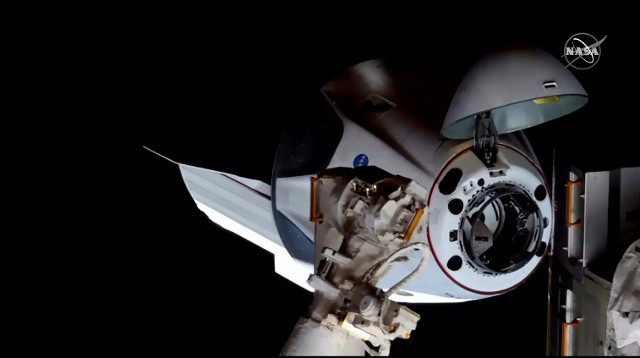
The Crew Dragon Endeavour spacecraft approaching the International Space Station (Image NASA TV)

A little while ago SpaceX’s Crew Dragon Endeavour spacecraft docked to the International Space Station’s Harmony module completing the first part of its SpX-DM2 (SpaceX Demonstration Mission 2), or SpaceX Demo-2, mission that began yesterday with its launch. After checking that the pressure is correctly balanced, the hatch will be opened to allow Doug Hurley and Bob Behnken to enter the Station.

The Crew Dragon spacecraft starts its SPX-DM2 mission blasting off atop a Falcon 9 rocket (Image NASA TV)

A little while ago SpaceX’s Crew Dragon spacecraft blasted off atop a Falcon 9 rocket from Cape Canaveral in its SpX-DM2 (SpaceX Demonstration Mission 2) or SpaceX Demo-2 mission. After about eleven minutes, it successfully separated from the rocket’s last stage and went en route to carry out its mission. This is the first crewed mission of the Crew Dragon spacecraft, in this case with Doug Hurley and Bob Behnken on board.

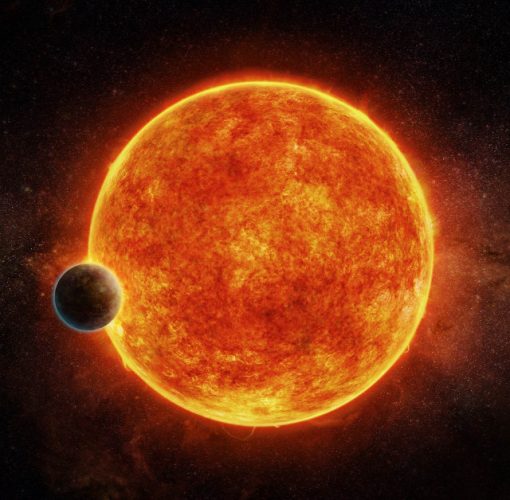
Artist's concept of a super-Earth with its star behind it (Image courtesy M. Weiss/CfA)

An article accepted for publication in the journal “Astronomy & Astrophysics” reports the discovery of a super-Earth in the system of HD 164922, a star that’s slightly smaller and slightly less massive than the Sun. A team of researchers led by Serena Benatti of the Italian National Institute for Astrophysics, Palermo, used the HARPS-N spectrograph installed on the Galileo Telescope, on the Canary Islands, to collect the data which, together with others previously collected with other instruments, allowed to discover the exoplanet designated as HD 164922d. The discoveries of exoplanets are increasingly made thanks to software that performs an automatic analysis of data collected by various telescopes, but in this case it’s the prize for the tenacity of astronomers who put together the data of years of observations conducted with various instruments.