2020

The 15 protoplanetary disks photographed by the VLTI

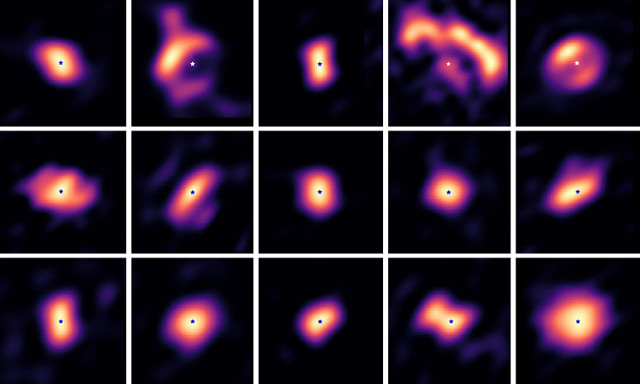
An article published in the journal “Astronomy & Astrophysics” reports the first case of high-resolution infrared observations of the internal areas of 15 protoplanetary disks performed by combining the four telescopes of the ESO VLT interferometer in Chile. A team of researchers led by Jacques Kluska of the Katholieke Universiteit Leuven in Belgium used the PIONIER instrument to achieve this result, which also shows traces of planetary formation. This type of observation offers new information on this process.

The Moon landers by Dynetics, SpaceX and Blue Origin / National Team

NASA has announced the choice of three companies to design and develop human landing systems for the Artemis program. These are essentially plans for a lunar lander among which one will be selected to be built for the mission that, according to plans, is supposed to bring American astronauts back to the Moon by 2024. The companies selected are Blue Origin (actually the first contractor for a group called National Team), Dynetics, and SpaceX. This stage of development involves a 10-month base period during which companies and NASA will work together on the selected projects. The total contract value is $967 million.

Artist's concept of the two massive black holes in the OJ 287 galaxy (Image NASA/JPL-Caltech)

An article published in “The Astrophysical Journal Letters” reports observations of a supermassive black hole passing through the disk of materials surrounding another object of the same type but even more massive in the galaxy OJ 287. A team of researchers used NASA’s Spitzer space telescope to monitor this event, which was predicted by a model created specifically to take into account the extreme environment generated in particular by the larger of the two black holes, whose mass is estimated at around 18 billion times the Sun’s. This model, from 2018, is the most recent and takes into account gravitational waves but also the no-hair theorem.

The possible orbit of an interstellar centaur asteroid

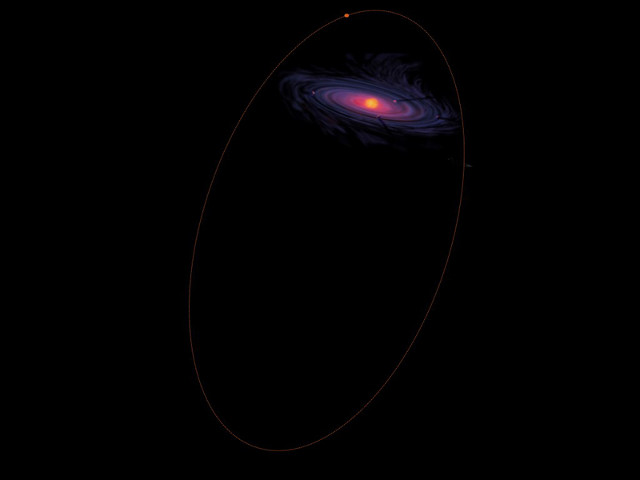
An article published in the journal “Monthly Notices of the Royal Astronomical Society” reports evidence of the interstellar origin of some asteroids of the centaur family and two transneptunian objects. Astronomer Fathi Namouni of the University of the Côte d’Azur in Nice, France, and his colleague Helena Morais of the Universidade Estadual Paulista, Brazil, used computer simulations to reconstruct the orbits of those asteroids backwards, concluding that they’re likely interstellar asteroids captured from another system that could have been much closer when the Sun and the stars born with it had just formed.

A screenshot from a simulation of an event such as GW190412

An article published on the arXiv server reports the observation of gravitational waves emitted by the merger of two black holes with very different masses. The scientists from the LIGO and Virgo collaborations used the data collected by their detectors to examine this merger, the first in which the mass of the two objects is so asymmetric given that the estimates made indicate that they were 8 and 30 times the Sun’s. The event, cataloged as GW190412, produced waves with shapes different from those found so far in mergers between objects of similar masses and contain information that allowed to obtain more precise measurements of the pair’s physical properties. It also made it possible to conduct new tests of the theory of general relativity, confirmed once again.