2020

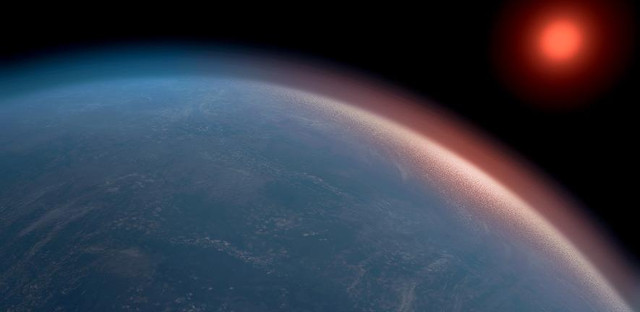
Artist's impression of K2-18b (Image courtesy Amanda Smith)

An article published in “The Astrophysical Journal Letters” reports a study on the potential habitability conditions of the exoplanet K2-18b. A team from the British University of Cambridge led by Nikku Madhusudhan conducted a series of simulations based on the possible values of mass, size, and atmosphere data value available on it to create various models compatible with the observations. According to the conclusions, under certain conditions there may be liquid water on its surface.

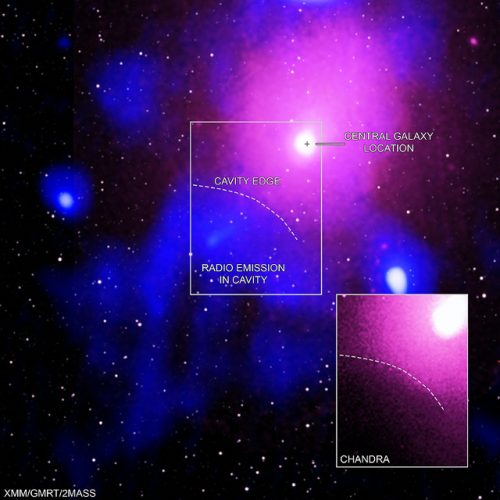
The outburst region in the Ophiuchus supercluster

An article published in “The Astrophysical Journal” reports the observation of what was called the largest explosion discovered in the universe after the Big Bang and caused by the supermassive black hole in the galaxy at the center of the Ophiuchus supercluster. A team of astronomers led by Simona Giacintucci of the Naval Research Laboratory combined X-ray observations with ESA’s XMM-Newton and NASA’s Chandra space telescopes with those at radio frequencies conducted with Murchison Widefield Array (MWA) and Giant Metrewave Radio Telescope (GMRT) radio telescopes to map the cavity generated by that cataclysmic event, about 15 times the Milky Way’s size.

The Sombrero Galaxy

An article published in “The Astrophysical Journal” reports a study on the Sombrero Galaxy and in particular on its halo. A team of researchers used the Hubble space telescope, finding a surprising abundance of stars rich in heavy elements, and computer simulations to try to understand the origin of this galaxy difficult to catalog because it’s a hybrid between the elliptical and the spiral shapes. The conclusion is that its growth occurred from the merging of two or perhaps even more massive galaxies in a chaotic process.

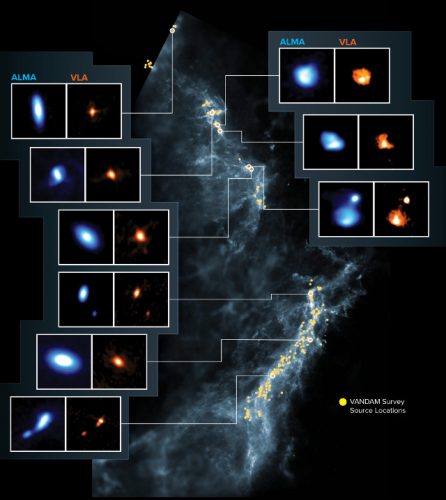
Protostars in the Orion Complex

Two articles published in “The Astrophysical Journal” report the study of a total of over 300 protostars with their protoplanetary disks in the Orion Complex, a group of molecular clouds that are perfect nurseries for the birth of new stars. A team of researchers led by John Tobin of the National Radio Astronomy Observatory (NRAO) used the data collected by the VLA and ALMA radio telescopes during the VLA/ALMA Nascent Disk and Multiplicity (VANDAM) survey to identify the four youngest protostars in the Orion Complex. A team expanded with the addition of other researchers investigated 328 protostars identified in those molecular clouds.

Artist's concept of hot Jupiter close to its star (Image courtesy University of Warwick/Mark Garlick)

An article published in the journal “Monthly Notices of the Royal Astronomical Society” reports a study on the exoplanet NGTS-10b, an ultra-hot Jupiter whose year lasts only about 18 hours. A team of researchers led by Dr James McCormac of the British University of Warwick used data collected during the NGTS survey to identify NGTS-10b thanks to its transits in front of its star. It’s the hot or ultra-hot Jupiter closest to its star observed so far, so close to it that in the distant future it could approach the point of being destroyed. This makes it an interesting object of study, also because observations conducted for several years will measure its orbit’s changes to understand if it’s really doomed.