
2020

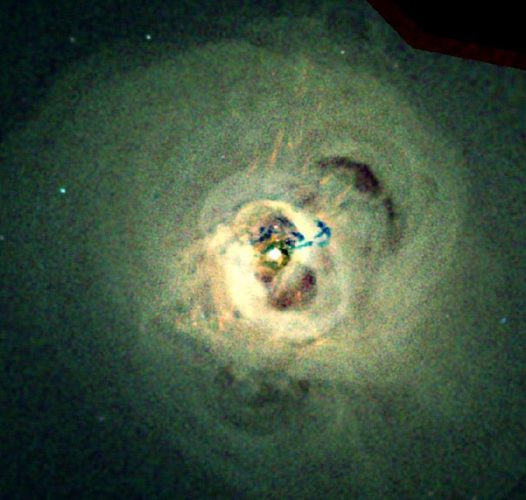
The center of the Perseus galaxy cluster (Image courtesy NASA/CXC/IoA/A.Fabian et al.)

An article published in the journal “Monthly Notices of the Royal Astronomical Society” reports the results of the study of molecular gas outflows in twelve massive galaxies at the center of galaxy clusters. A team of researchers analyzed data collected with the ALMA radio telescope to conduct this study finding that the active galactic nuclei (AGNs) of the observed galaxies cause periodic energy outbursts in the form of radiation or as jets of particles that move at speeds close to the speed of light. The energy releases cause gas outflows which can be pushed even beyond the galaxy borders. This mechanism limits the approach of the gas to the central supermassive black hole, decreasing the outbursts in what’s called a feedback. The researchers are especially studying the consequences on star formation and the possibility that a galaxy might become quenching.

Fornax A with its lobes

An article published in the journal “Astronomy & Astrophysics” reports a study of the galaxy known as Fornax A or as NGC 1316. A team of researchers led by Filippo Maccagni of the Italian National Institute of Astrophysics, Cagliari, used data collected by five different telescopes to find evidence of repeated nuclear activity that formed what were called radio lobes, gigantic plasma halos invisible at optical frequencies but bright at radio frequencies. For this reason, the MeerKat radio telescope was crucial in obtaining the best observations ever obtained by Fornax A.

The Spitzer space telescope being prepared (Photo NASA)

NASA’s Spitzer space telescope ended its mission with its final shutdown, which happened when in the USA it was afternoon. Launched on August 15, 2003, it’s been an instrument crucial for infrared astronomy in studies of various kinds ranging from those of solar system’s objects to those of distant galaxies passing through those of exoplanets.

The Tarantula Nebula (Image NASA/JPL-Caltech)

NASA has published a new image of the Tarantula Nebula, a region of the Large Magellanic Cloud, one of the Milky Way’s satellite dwarf galaxies. The image combines data from multiple observations conducted with the Spitzer space telescope, whose activity is about to cease. The Tarantula Nebula was one of the first targets studied with this instrument in 2003, after it was put into orbit, and demonstrated its capabilities. Once again, Spitzer offers a view of the structures existing in that area and above all of the many star formation processes taking place.

Artist's concept of the exoplanet KELT-9b (Image NASA/JPL-Caltech)

An article published in “The Astrophysical Journal Letters” reports a study of the exoplanet KELT-9b with evidence that the conditions are so extreme as to break hydrogen molecules. A team of researchers led by Megan Mansfield of the University of Chicago used NASA’s Spitzer space telescope to find evidence that KELT-9b is an extreme example even in the hot Jupiter planet class due to the conditions existing on its surface. Not accidentally, it’s the hottest known planet and on its dayside hydrogen molecules are broken and then recompose when the atoms move on its nightside.