2020

A portion of the Subaru/XMM-Newton Deep Field with a dying galaxy in the middle (Image courtesy NAOJ/M. Tanaka)

Two articles, one published in “The Astrophysical Journal Letters” and one in “The Astrophysical Journal”, report the results of studies on ancient quenching galaxies, which means that they strongly reduced or even finished their star-formation activity. Two teams of researchers with many of them in common used data collected with various telescopes to study these galaxies and establish that we see the oldest as it was about 1.5 billion years after the Big Bang. These studies offer new information to improve galaxy formation models.

Artist's concept of protostar

An article published in the journal “Nature Astronomy” reports the observation of natural masers that revealed a heat wave in the protostar G358.93-0.03-MM1, or simply G358-MM1. A team of researchers led by Ross Burns of NAOJ (National Astronomical Observatory of Japan) carried out the detections as part of the M2O (Maser Monitoring Organization) network of astronomers, specialized in the study of astrophysical masers to understand their nature. In the specific case, it’s a massive protostar and the heat wave coming from it confirms that this type of star passes through a non-linear formation process.

Salts of ammonium chloride (Photo courtesy University of Bern)

Two articles published in the journal “Nature Astronomy” report the results of as many analyzes of data collected by ESA’s Rosetta space probe which reveal the presence of compounds such as ammonium salts on the comet 67P/Churyumov-Gerasimenko. A team of researchers led by Kathrin Altwegg of the University of Bern, Switzerland, analyzed the data trying to understand the reasons for the scarcity of nitrogen on the comet, concluding that its presence is actually difficult to detect because a part is tied to ammonium salts. These salts are among the building blocks of molecules that include some precursors of life such as urea and glycine, already found on the comet. Another team discovered in the data traces of aliphatic compounds, considered essential for life on Earth, on the comet.

Six so-called bloated stars confirmed at the center of the Milky Way

An article published in the journal “Nature” reports the identification of what were called G-objects that orbit the supermassive black hole at the center of the Milky Way, Sagittarius A* or simply Sgr A*. A team of researchers led by Anna Ciurlo of UCLA already announced the discovery of three new G-objects, now they confirm their existence and announce the identification of a fourth one. They add to the two G-objects already confirmed a few years ago. New indications could confirm the hypothesis that they’re the result of mergers of binary systems’ stars.

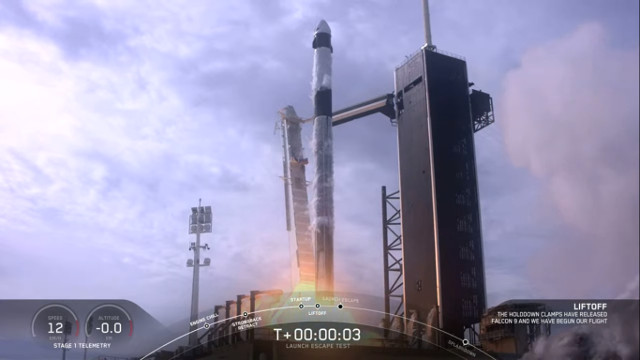
La navicella spaziale Crew Dragon al decollo per il test di interruzione d'emergenza del lancio (Immagine cortesia SpaceX)

SpaceX has just completed the In-Flight Abort Test of one of its Crew Dragon spacecraft, the version of Dragon 2 produced for the transport of astronauts. A Falcon 9 rocket was deliberately blown up at the moment of maximum dynamic pressure, Max q in jargon, to test that the the systems which in a normal launch are used to rescue the crew aboard the Crew Dragon work properly.