2020

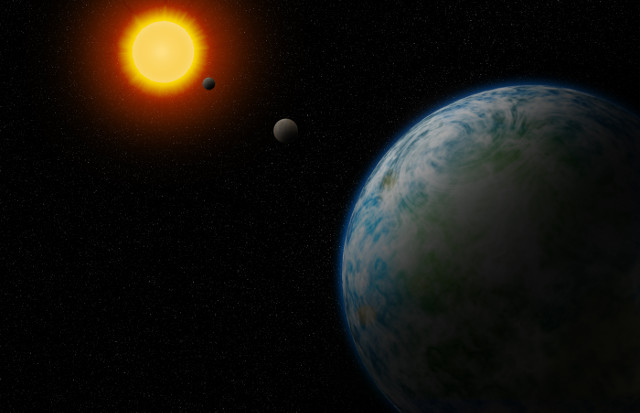
Artist's concept of the GJ180 system (Image Robin Dienel, courtesy of the Carnegie Institution for Science)

An article published in “The Astrophysical Journal Supplement Series” reports the identification of five new exoplanets, the detection of eight exoplanet candidates that will be verified, and the confirmation of three exoplanets previously detected but not yet confirmed. A team of astronomers led by Fabo Feng and Paul Butler of the Carnegie Institution for Science selected and reanalyzed data gathered in the survey conducted with the UVES instrument mounted on ESO’s VLT using other verification instruments. Two of the new exoplanets are super-Earths in their system’s habitable zone, the first of this type that orbit around red dwarfs not tidally locked,, a positive factor because having always day on one face and always night on the other generates extreme temperatures that lower the chances of life being born.

New confirmations that phosphorus was brought to Earth by comets

An article to be published in the journal “Monthly Notices of the Royal Astronomical Society” reports a study tracing the journey of phosphorus from star formation to comets. A team of researchers led by Víctor Rivilla of the Italian National Institute of Astrophysics used the ALMA radio telescope and data collected by ESA’s Rosetta space probe’s ROSINA instrument on comet 67P/Churyumov–Gerasimenko to understand where phosphorus is formed and how comets may have brought it to Earth, where it’s needed by life forms.

8-micron grain from the Murchison meteorite (Image courtesy Janaína N. Ávila)

An article published in the journal “Proceedings of the National Academy of Sciences” reports the dating of grains of silicon carbide that were part of the Murchison meteorite, which date back to different times with the oldest one dating back about 7 billion years ago. A team of researchers led by Philipp Heck of the University of Chicago analyzed particles contained in the Murchison meteorite by examining the elements contained and in particular the neon isotopes produced by galactic cosmic rays that struck those grains over time.

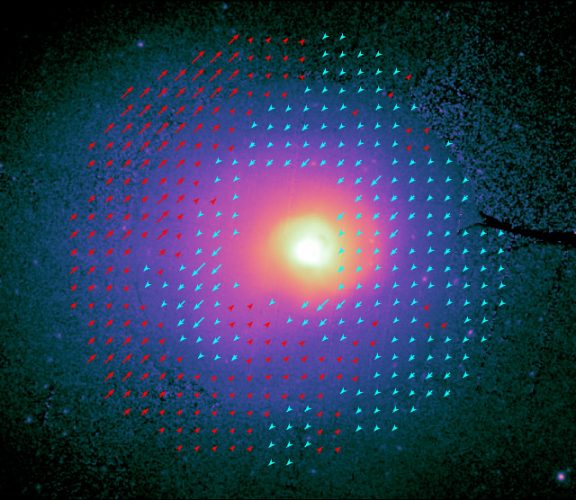
A map of plasma motions in the Perseus and Coma galaxy clusters

An article published in the journal “Astronomy & Astrophyiscs” reports the mapping of the distribution and motion of hot gas within the Perseus and Coma galaxy clusters. A team of researchers led by Jeremy Sanders of the Max Planck Institute for extraterrestrial physics in Garching, Germany, used in particular ESA’s XMM-Newton space telescope to study those two large clusters and detect the gas that, at very high temperatures and in the form of a plasma, shines at X-rays. This mapping offers new information on the formation and evolution of galaxy clusters.

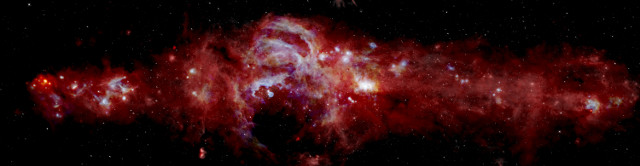
New details of the center of the Milky Way observed by the SOFIA flying telescope

An article submitted for publication in “The Astrophysical Journal” reports the initial results of an investigation about the center of the Milky Way conducted using the SOFIA flying telescope to capture infrared details never seen before and therefore useful for mapping an area 600 light years across. A team of researchers integrated those observations with data previously collected using NASA’s Spitzer space telescope and ESA’s Herschel space observatory obtaining a map of the center of the galaxy useful for example to understand where gas is concentrated which can lead to the new stars’ formation, how some of the most massive stars in the Milky Way formed in a relatively small region or where materials are likely to be devoured by the supermassive black hole at the center of the galaxy.