
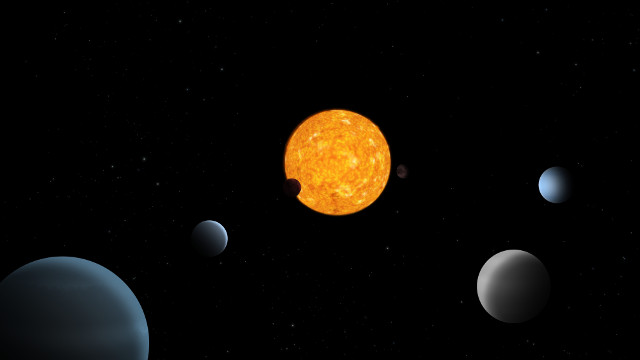
An article published in the journal “Astronomy & Astrophysics” reports a study on the TOI-178 system that confirms the presence of six planets and indicates that the orbits of five of them are in resonance. A team of researchers led by Adrien Leleu of the Université de Genève and the University of Bern, Switzerland, used ESA’s CHEOPS space telescope and other instruments to confirm that there are at least six planets orbiting TOI-178. The result is a unique situation, with very different planets of which five follow a 2:4:6:9:12 resonance pattern.
About 205 light years from Earth, the star TOI-178 has a mass that is about 65% of the Sun’s. TOI means TESS Object of Interest, and is due to the fact that the first two planets orbiting that star were discovered by NASA’s TESS Space Telescope, the exoplanet hunter launched on April 18, 2018.
Subsequent observations conducted with ESA’s CHEOPS space telescope, launched on December 18, 2019, confirmed the presence of six planets and the uniqueness of this planetary system. CHEOPS was designed to study the characteristics of exoplanets discovered with other instruments, but in this case it allowed to confirm the existence of some of them.
Follow-up observations of the TOI-178 system were conducted with the NGTS (Next-Generation Transit Survey) observatory, with the ESPRESSO (Echelle SPectrograph for Rocky Exoplanet and Stable Spectroscopic Observations) instrument mounted on the VLT (Very Large Telescope), and with the SPECULOOS (acronym for Search for Planets EClipsing ULtra-cOOl Stars), Observatory all ESO’s instruments in Chile.
Calculations of the orbits of five of TOI-178’s planets, except the innermost one, indicate a so-called Laplace resonance, a case where their periods of revolution can be expressed in whole numbers, in this case 2:4:6:9:12. A resonance among five planets is a unique case and indicates that this planetary system evolved quietly.
The gravitational interactions that lead to a resonance can be disturbed in the case of catastrophic events such as impacts that alter a planet’s orbit and thus the global configuration. The innermost planet isn’t in resonance, and this could be due to tidal forces exerted by the star, as it’s very close to it, to the point that it could even be a so-called lava planet.
TOI-178’s planetary system is curious also regarding the densities of the various planets. In the solar system, there are rocky planets and a group of gas planets whose density is higher in the ones closest to the Sun and lower in the ones further away. In the TOI-178 system the density variations are quite different and appear to follow a random order.
Adrien Leleu commented on the contrast between the order of the resonance among five of the six planets of TOI-178 and the lack of patterns in their density, noting that this challenges our understanding of the formation and evolution of planetary systems. He and his colleagues intend to keep on studying this system to better understand the interactions among the planets and, especially in the case of the innermost one, with the star. Extraordinary systems like this can help improve our models of their formation.

Permalink