An article published in the journal “Monthly Notices of the Royal Astronomical Society” reports the detection of a hydrogen filament about three trillion kilometers long in the cosmic neighborhood. A team of researchers led by Yuanming Wang, a doctoral candidate at the Australian University of Sydney, and Dr. Artem Tuntsov of Manly Astrophysics, used the ASKAP radio telescope to discover this ultra-low-temperature gas just 13 light-years from the Earth. In recent years, a lot of gas that forms the baryonic matter considered to be missing has been discovered in filaments that unite different galaxies, in this case it’s inside the Milky Way and in astronomical terms very close.
Despite recent discoveries, theoretical calculations predict that the amount of baryonic matter, the so-called normal matter as opposed to dark matter, should be twice that observed. It’s not easy to discover cold hydrogen that forms very large filaments but with relatively small masses and very low or even non-existent emissions.
The latest generation instruments are offering a great help in this type of research, for example ASKAP (Australian Square Kilometer Array Pathfinder), one of the precursors of SKA, the next generation radio telescope. In this case, the gas is too cold to even emit radio waves, but Yuanming Wang devised a method to detect its presence. It’s based on the observation of radio sources in the sky with the ASKAP radio telescope to see the distortions caused by the passage through gas clumps. The outcome was positive.
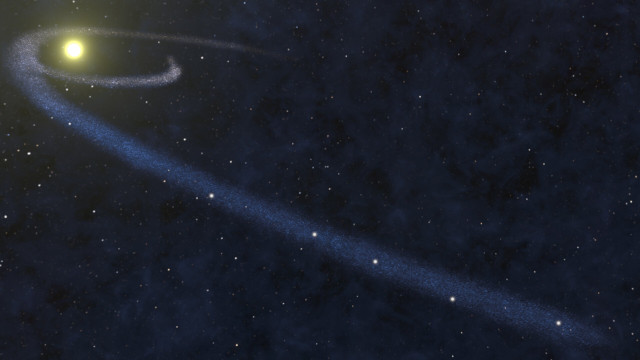
Dr. Artem Tuntsov explained that he and his colleagues are unsure of the nature of the cloud they detected by mapping what they called a shimmering of the radio sources behind it. It could be a kind of hydrogen “snow cloud” that was influenced by a nearby star as shown in the image (Courtesy University of Sydney. All rights reserved). A star’s gravity might have turned a cloud into a very elongated filament.
Dr Keith Bannister, Principal Research Engineer at CSIRO (Commonwealth Scientific and Industrial Research Organization), the agency that runs the ASKAP radio telescope, explained that ASKAP’s wide field of view allows to see tens of thousands of galaxies in a single observation, and in this case this made it possible to measure the shape of the gas cloud. Professor Tara Murphy, Yuanming Wang’s supervisor, added that in the coming years they should be able to use similar methods with ASKAP to detect a large number of such structures in our galaxy.
It may seem paradoxical that a three-trillion-kilometer-long filament that is astronomically very close to the Earth got discovered only now. That hydrogen is so cold that it’s inert and its estimated mass is comparable to the Moon’s, which means it’s very thin. Finding clouds and filaments of this type will help to better understand the distribution of matter in the universe, so studies of this type will continue.
