
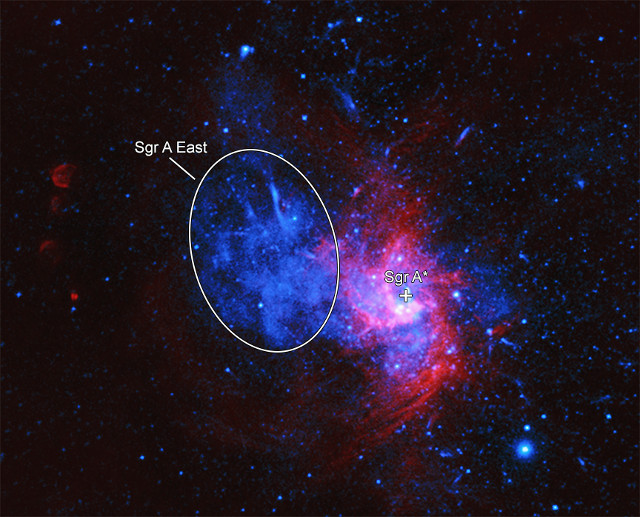
An article to be published in “The Astrophysical Journal” reports a study on supernova remnants cataloged as Sagittarius A East, or simply Sgr A East. A team of researchers used observations conducted with NASA’s Chandra X-ray Observatory and the VLA radio telescope to study those remnants and concluded that they were generated by a rare type of supernova, the type Iax. The results can help astronomers understand the different ways a white dwarf can explode.
A white dwarf is what remains of a small or medium-sized star after it finished its normal life cycle. Normally, that’s the final stage in the life of those stars but if a white dwarf has a companion, it can steal gas from it, and this triggers new thermonuclear reactions. If the amount of materials is enough to exceed a critical limit, even a white dwarf can become a supernova, classified as type Ia.
In some cases, the characteristics of a Type Ia supernova are different from normal, the case classified as Iax. It’s not clear what causes these differences but the theory currently most accepted is that there are thermonuclear reactions that travel much slower through the star than the others.
The X-ray emissions from the source classified as Sgr A East indicate that it’s a candidate that has a strong probability of being what remains of a Type Iax supernova. By analyzing data collected over the course of 35 days using the Chandra X-ray Observatory, the researchers found unusual patterns linked to elements such as iron and nickel in the debris. The image (X-ray: NASA/CXC/Nanjing Univ./P. Zhou et al. Radio: NSF/NRAO/VLA) shows the X-ray emissions detected by Chandra in blue and the radio emissions detected by VLA (Very Large Array) in red. Close to those remnants is Sagittarius A*, the supermassive black hole at the center of the Milky Way.
So far, only three Type Iax supernovae have been confirmed in the Milky Way and there are two other candidates less than 2,000 years old. In other galaxies, a third of type Ia supernovae belong to the Iax subclass. A confirmation of the nature of Srg A East would indicate that the Milky Way is average in the ratio of supernovae within Type Ia.
The nature of Sgr A East has been under discussion for years, but the doubt concerned the possibility that the supernova was generated by the collapse of a normal star or a white dwarf in type Ia. This new study based on long-term observations showing the elements generated by the supernova offers evidence of its Type Iax nature. Such studies are important to understand the various mechanisms behind supernovae, in this case, related to white dwarf explosions. Different types of supernovae generate different elements that are ejected into interstellar space and can help form new planets.
