
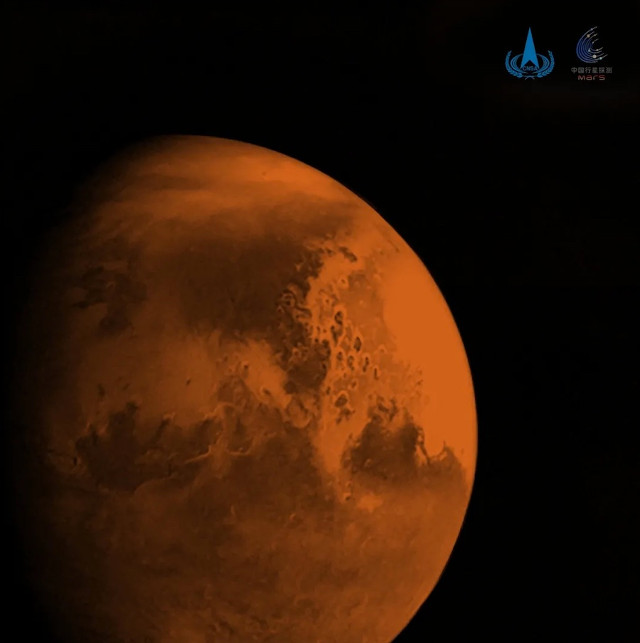
Yesterday, the Tianwen 1 mission reached the planet Mars, and the spacecraft which includes a space probe, a lander, and a rover entered its orbit correctly. Launched on July 23, 2020, it’s an ambitious mission for China with plans to explore Mars in various ways after successfully starting various missions to the Moon. The main spacecraft engined burned for about 15 minutes to perform the braking maneuver needed to enter an orbit that will reach up to 400 kilometers of altitude. The landing timeline and location in the Utopia Planitia region of the lander and rover will be decided later for a phase of the mission that could take place in May or June.
The Tianwen 1 mission is the first to be conducted by China on another planet after the experiences with various Moon missions, some of which are still ongoing. Only the ExoMars program, a collaboration between ESA and Roscosmos, has ambitions at that level with various vehicles to explore Mars at the same time from the orbit and the ground. However, the Chinese authorities decided to keep a low profile from a media point of view. This means that there were no live broadcasts of the various phases of the mission, confirmed only by subsequent press releases.
A success of the various phases of the Tianwen 1 mission would take the Chinese space program to the next step. China’s Chang’e 5 mission returned Moon samples to Earth at the end of 2020, the next challenge would be to bring Martian samples back to Earth. Another expansion of the Chinese space program would lead to sending space probes beyond Mars, into the asteroid belt and the Jupiter system.
There’s still a lot to do in the Tianwen 1 mission before thinking about the next ones. The updates will arrive when the authorities deem it, otherwise we’ll have to wait for the announcements about the next phases of the mission. China is the sixth nation to have sent a space probe to Mars, but so far only the USA and the then USSR have been successful in landing vehicles on the red planet. The Chinese attempt could take place in May or June and will be another important test for the national space ambitions.
