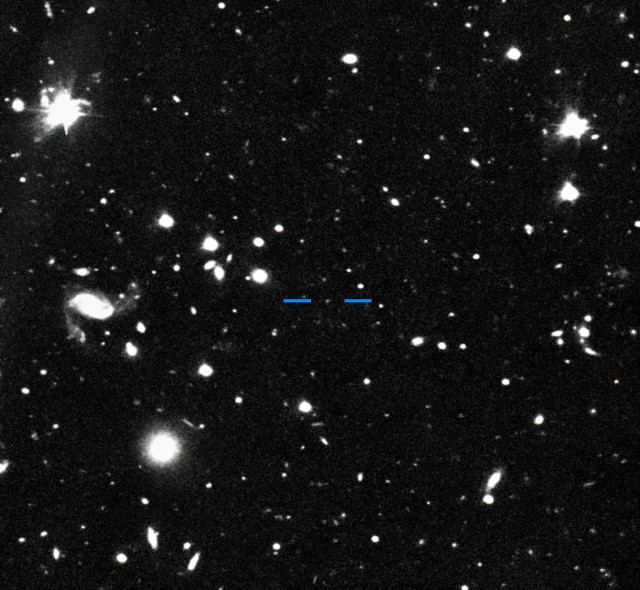
A team of astronomers announced that they obtained observations confirming that 2018 AG37, nicknamed Farfarout, is the most distant object from the Sun within the solar system. Scott Sheppard of the Carnegie Institution for Science and his colleagues Chad Trujillo and David Tholen are specialists in researching objects in the Kuiper Belt and had identified this object already in 2018. However, it’s so far away that there were uncertainties about its measurements. and only now have astronomers announced that it’s currently at a distance from the Sun estimated at 132 times the Earth’s. Its distance exceeds that of 2018 VG18, nicknamed Farout, discovered by the same astronomers.
In recent years, the search for trans-Neptunian objects have also been stimulated by theoretical calculations that predict the presence of a planet beyond the orbit of Neptune, in the so-called Kuiper Belt. Called Planet X or Planet 9, its position varies greatly depending on the calculations related to the alleged gravitational effects it’s supposed to have on the various smaller objects present in the area.
So far, the various researches have led to the discovery of minor planets that are still interesting from an astronomical point of view since they are in an area of the solar system that is still poorly known. At distances such as Farfarout, precise observations require long periods to define an object’s characteristics. That’s is why its discoverers continued to observe it with the Gemini North telescope in Hawaii and the Magellan telescope in Chile. Their efforts have been rewarded, and they brought evidence that it’s the farthest object from the Sun within the solar system discovered so far.
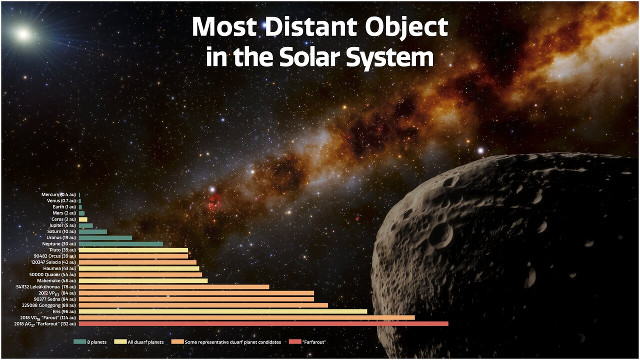
The bottom image (NOIRLab/NSF/AURA/J. da Silva) shows an artist’s concept of Farfarout and the graph bars indicate the distances from the Sun of planets, dwarf planets, dwarf planet candidate, and Farfarout.
Years of observations made it possible to reconstruct Farfarout’s orbit, which is truly elliptical. Now its distance from the Sun is 132 times the Earth’s, but according to calculations it can reach up to 175 times the Earth’s while at its closest point it’s “only” 29 times the Earth’s, within Neptune’s orbit. This suggests that its orbit is affected by Neptune, and Chad Trujillo explained that it was probably thrown into the outer solar system in the past by passing too close to the planet.
Based on its distance and brightness, the researchers estimated Farfarout to be around 400 kilometers across. This means that it has the minimum size to be considered a dwarf planet, but further studies are needed for it to be included in this category by the International Astronomical Union (IAU).
Farfarout’s year probably lasts over an Earth millennium, so it will take a long time before it crosses Neptune’s orbit again. Its observations will continue to better reconstruct its orbit and obtain more precise information on its characteristics. It’s possible that other, even more distant, objects will be discovered thanks to increasingly sensitive instruments that can identify them despite their distance and their very low brightness. Maybe we’ve just begun to really discover the Kuiper Belt.