
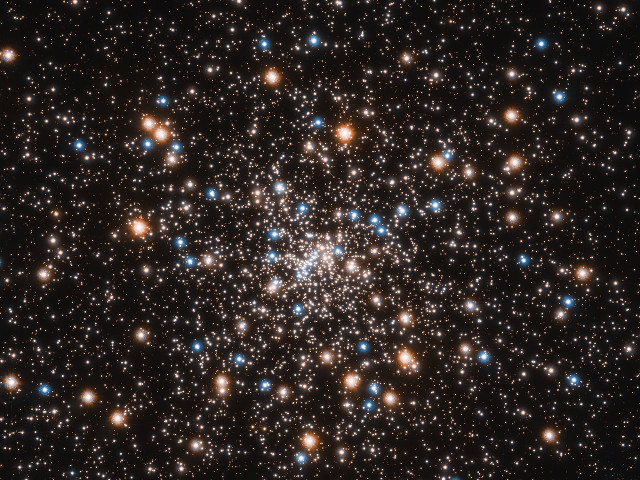
An article published in the journal “Astronomy & Astrophysics” reports evidence of the presence of a group of black holes in the globular cluster NGC 6397. Eduardo Vitral and Gary A. Mamon of the Institut d’Astrophysique de Paris (IAP) used observations conducted with the Hubble Space Telescope and the Gaia space probe to study the core of NGC 6397 expecting to find evidence of the presence of an intermediate-mass black hole that was a hidden mass, but the analyzes of the star movements within the cluster indicated the presence of various stellar-mass black holes.
About 7,800 light years from Earth, the globular cluster NGC 6397 is one of the closest to Earth. In such clusters, the brightness increases with the approach to their core until it reaches a certain distance from it, but this one is a so-called core-collapsed cluster because it underwent a process that leads to a constant increase in brightness up to its core.
Globular clusters are very ancient and NGC 6397 seems an extreme case even in its category as it seems almost as old as the universe. These clusters are normally very dense, and this favors stellar interactions which, in the case of black holes, can lead to mergers and therefore to the formation of intermediate-mass black holes. They’re midway between stellar-mass black holes and supermassive black holes, but so far only a few candidates have been found. The consequence is that there are still a lot of discussions around them.
Eduardo Vitral and Gary A. Mamon hoped to find at least one intermediate-mass black hole candidate in the globular cluster NGC 6397. To look for its traces, they analyzed information collected with the Hubble Space Telescope over several years and found in the Gaia space probe’s Data Release 2. This means images but also data on the movements of the stars within NGC 6397.
The two researchers were thus able to analyze the interactions taking place among those stars, and the result was that they found strong evidence of the presence of an invisible mass in the central regions of the globular cluster NGC 6397. The surprise came when they discovered that such mass wasn’t point-like but extended to a few percentage points of the cluster size. It could only be the remains of massive stars that fell towards the center of the cluster due to gravitational interactions with other, less massive, stars. Stellar evolution models led the researchers to conclude that most of that invisible mass must be stellar-mass black holes.
Eduardo Vitral pointed out that the study conducted with Gary Mamon is the first to provide both the mass and the extent of what appears to be an collection of mostly black holes in a core-collapsed globular cluster.
This study offered different results from what the researchers hoped for but they’re still very interesting. The concentration of black holes in the globular cluster NGC 6397 increases the possibility of mergers with the generation of gravitational waves that could be detected. These would be new possibilities to study this and other globular clusters that could have similar characteristics.
