February 2021

The first image of Mars captured by the Mars Rover Perseverance (Photo NASA/JPL-Caltech)

A few hours ago, the Mars Rover Perseverance and the Ingenuity helicopter landed successfully on Mars, in Jezero Crater. Launched on July 30, 2020, these are the two vehicles of NASA’s Mars 2020 mission. With more than 1,000 kg of weight on Earth, Perseverance even surpasses the Mars Rover Curiosity, of which it’s an evolution. For at least a Martian year, it will examine the area of ​​a geologically very interesting crater, collecting samples that mighy be returned to Earth by a future mission.

The Progress MS-16 spacecraft blasting off atop a Soyuz-2.1a rocket (Image NASA TV)

A few hours ago, the Progress MS-16 spacecraft blasted off atop a Soyuz-2.1a rocket from the Baikonur Cosmodrome in Kazakhstan. After about nine minutes it successfully separated from the rocket’s last stage and was placed on its route. The cargo spacecraft began its resupply mission to the International Space Station also called Progress 77 or 77P. In this mission, the route used is the one that requires about two days.

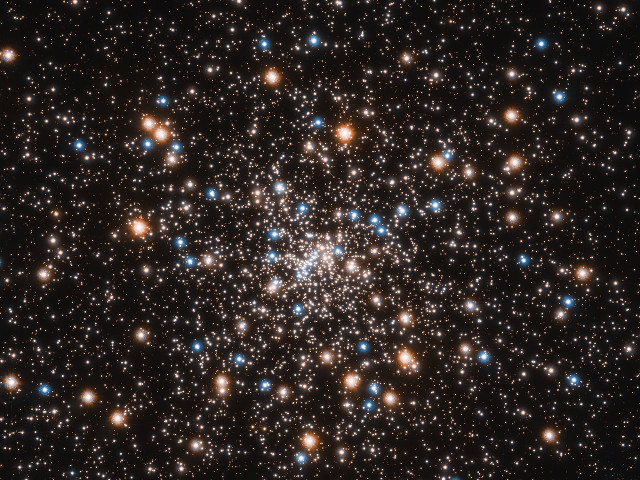
The globular cluster NGC 6397 seen by Hubble (Image NASA, ESA, and T. Brown and S. Casertano (STScI). Acknowledgement: NASA, ESA, and J. Anderson (STScI))

An article published in the journal “Astronomy & Astrophysics” reports evidence of the presence of a group of black holes in the globular cluster NGC 6397. Eduardo Vitral and Gary A. Mamon of the Institut d’Astrophysique de Paris (IAP) used observations conducted with the Hubble Space Telescope and the Gaia space probe to study the core of NGC 6397 expecting to find evidence of the presence of an intermediate-mass black hole that was a hidden mass, but the analyzes of the star movements within the cluster indicated the presence of various stellar-mass black holes.

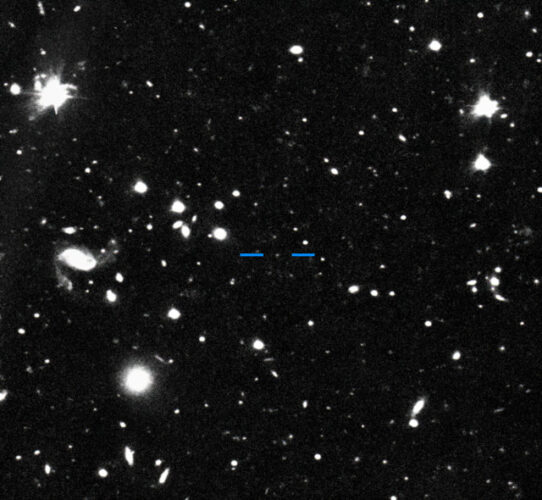
Farfarout (2018 AG37) seen on January 15, 2018, by the Subaru telescope (Image courtesy S. Sheppard)

A team of astronomers announced that they obtained observations confirming that 2018 AG37, nicknamed Farfarout, is the most distant object from the Sun within the solar system. Scott Sheppard of the Carnegie Institution for Science and his colleagues Chad Trujillo and David Tholen are specialists in researching objects in the Kuiper Belt and had identified this object already in 2018. However, it’s so far away that there were uncertainties about its measurements. and only now have astronomers announced that it’s currently at a distance from the Sun estimated at 132 times the Earth’s. Its distance exceeds that of 2018 VG18, nicknamed Farout, discovered by the same astronomers.